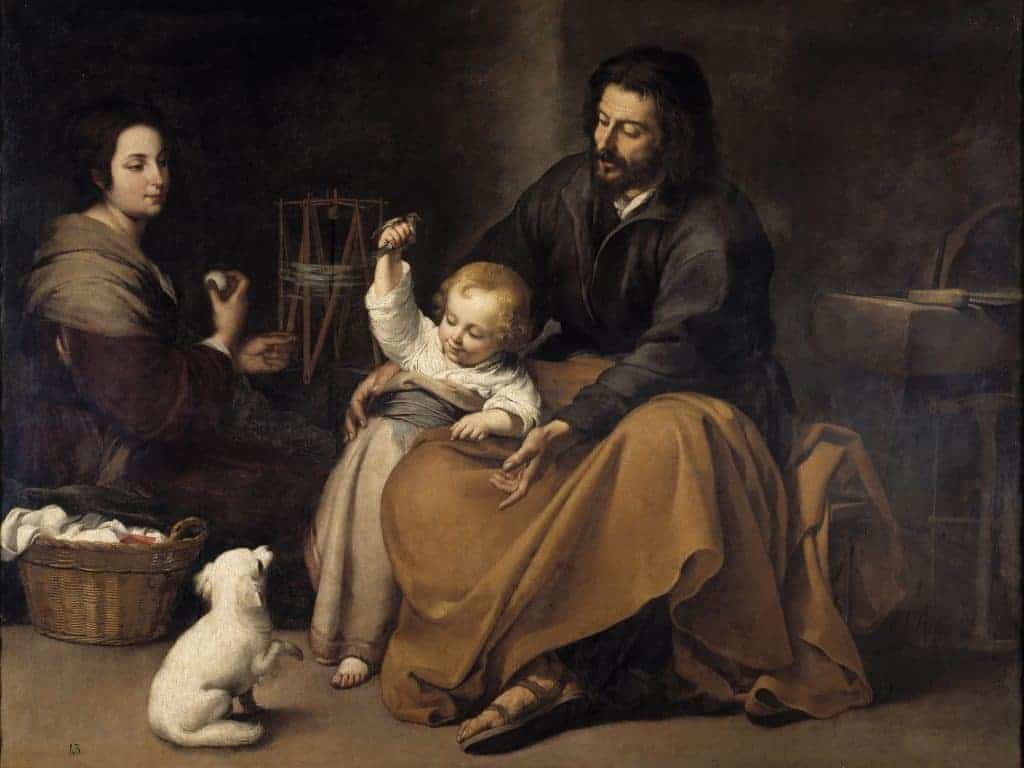
Mary
The Holy Spirit will come upon you, and the power of the Highest will overshadow you; therefore, also, that Holy One who is to be born will be called the Son of God.
—Gabriel to Mary in Luke 1:35, announcing to her she would become Jesus’ mother—
Key point: Only a woman could be Jesus’ mother, and Mary was God’s chosen individual to fill that critical role.
Go here for summaries of all the articles in this series.
One aspect of the Christmas story that sermons and Bible studies often overlook is the contrast between the responses of Mary and Joseph to the birth of Jesus and the differing roles that each individual filled. Such information is extremely insightful in light of our current series on myths that led to the Supreme Court’s redefining marriage in the United States. One overarching myth is that gender differences are irrelevant in parenting. The biblical account of Jesus’ arrival on earth as a helpless baby, as well as Joseph’s responses to subsequent efforts to kill Him, demonstrate that even God’s Son needed both a mother and a father—just as all children do.
What do Mary’s and Joseph’s unique roles in Jesus’ arrival and earliest years teach us? In this post we will consider Mary; next time, Joseph. In all but one instance—Mary’s Quiet Reflections—we’ll mark Mary’s journey with the names of individuals who played important roles in her life.
Gabriel and Elizabeth
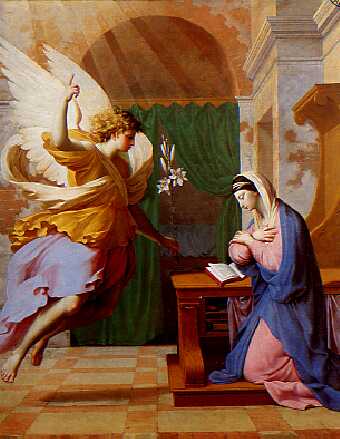
The Annunciation by Eustache Le Sueur
Mary was taken aback when, in the sixth month of Elizabeth’s pregnancy, the angel Gabriel appeared to her suddenly and announced that she was highly favored and would become the mother of the Messiah. Luke records the events from Mary’s perspective.

La Visitation by Philippe de Champaigne
Mary was submissive to God’s plan, readily expressing a willingness to fulfill her role in it—as awesome as that role was. In fact, she rejoiced in being given both the responsibility and the privilege of being mother to God’s Son.
The woman who could understand her situation best was her relative, Elizabeth, of whom Gabriel had declared, “Now indeed, Elizabeth your relative has also conceived a son in her old age; and this is now the sixth month for her who was called barren. For with God nothing will be impossible.” While it was true that Mary’s and Elizabeth’s situations were more different than alike, they were similar enough to provide the foundation for a special bond between the two women.
Mary was indeed favored by God, but her situation also involved great risk. She was certain to be misunderstood. Pregnancies occur as a result of intimacy between a man and a woman. This was going to be a once-in-history exception—but only Mary and a select few in her life would have to understand this. Of course, Joseph, Mary’s husband-to-be, would have to be one of those select few. Many people never came to understand. Years later, the Pharisees would subtly accuse Jesus of having been conceived illegitimately (see John 8:41; context vv. 31-41).
Joseph
Joseph would believe and support Mary and marry her as planned, but understandably, God had to intervene to confirm to him what actually had happened. Joseph would be used of God to meet some very critical needs that arose in the early years of his adopted Son’s childhood.
Robert Campin, 1425-1428
We’ll consider Joseph’s roles of husband and father next time. For now, let’s reflect the swirl of events that culminated in Jesus’ birth and the arrival of shepherds at His bedside. The events we recount here are recorded in Luke 2:1-52.
Caesar Augustus issued a decree that the Roman world would be registered, and residents had to travel to the places from which their ancestors came. Joseph, who had descended from David’s line, traveled with Mary, his wife, to David’s hometown, Bethlehem. Mary was quite far along in her pregnancy by this time, so the journey had to be difficult. After arriving in Bethlehem, the couple faced an urgent situation. The time for Jesus’ arrival had come! Unable to find lodging in a local inn, they had to settle for a stable, and there God’s Son was born into the world as an innocent, helpless baby. Let’s put it another way. Mary became the “doorway” through which Jesus, God’s Messiah, entered the world. Only a woman could be used of God in this way.
The Shepherds
That same night, as shepherds were keeping watch over their flocks in nearby fields, a messenger from God—an angel—suddenly appeared! The shepherds were astonished, but the angel reassured them,
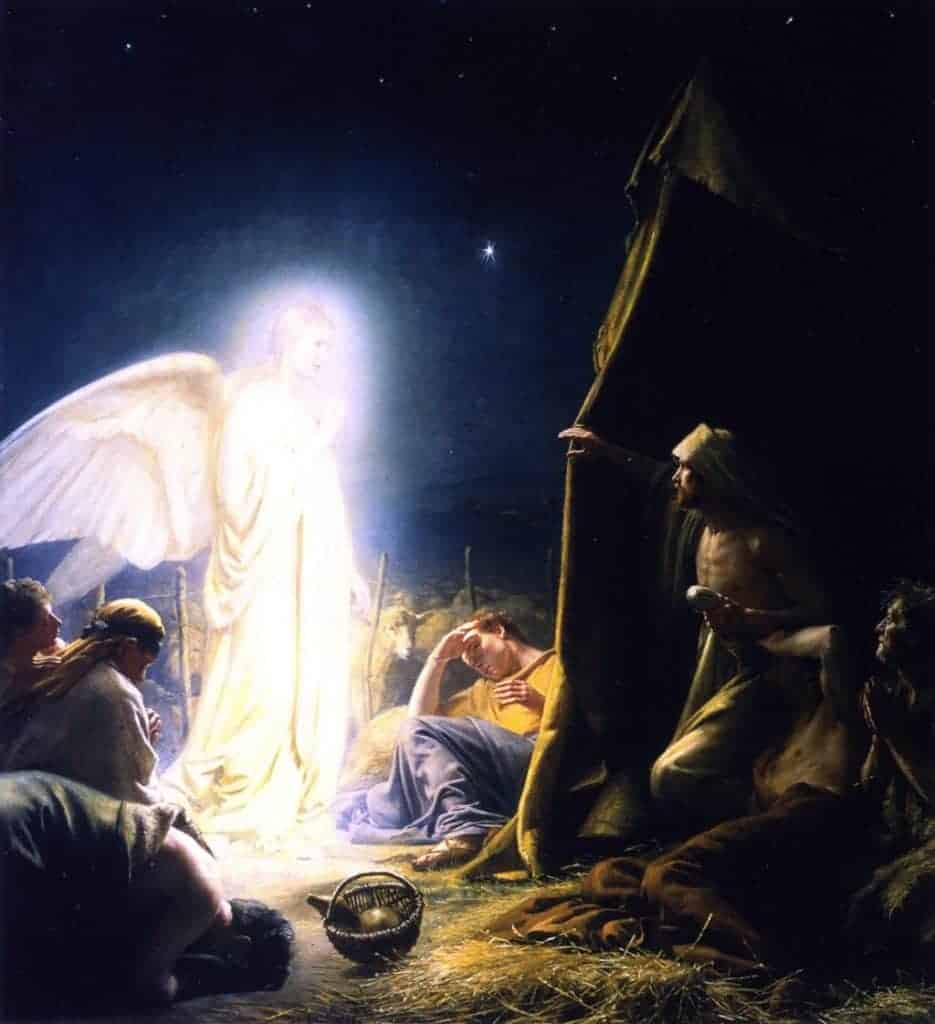
The Shepherds and the Angel by Carl Bloch, 1879
10 “Do not be afraid, for behold, I bring you good tidings of great joy which will be to all people. 11 For there is born to you this day in the city of David a Savior, who is Christ the Lord. 12 And this will be the sign to you: You will find a Babe wrapped in swaddling cloths, lying in a manger.”
After making his announcement, the angel no longer was alone, but joined by an army of angels who praised God and spoke of peace on earth “to those on whom his favor rests” (vv. 13-14, NIV). The shepherds wasted no time in making their way to Bethlehem and finding Mary, Joseph, and the Baby, who was lying in an animal’s feeding trough, just as the shepherds had been told.
The shepherds’ lives were forever changed! Surely they talked for the rest of their lives about this otherwise ordinary night when the sky had split open and an angel announced the birth of the One who was the Savior, the Christ, and the Lord. Momentarily, we’ll see evidence of their inability to keep quiet. “Lying in a manger,” He Himself would be a sign to them!
The shepherds found things exactly as the angel had described them. After seeing Him, they “made widely known the saying which was told them concerning this Child. And all those who heard it marveled at those things which were told them by the shepherds” (vv. 17-18). In addition, Luke tells us, “Then the shepherds returned, glorifying and praising God for all the things that they had heard and seen, as it was told them” (v. 20).
Mary’s Quiet Reflections
“But Mary,” Luke writes in verse 19, “kept all these things and pondered them in her heart.” The translators of the New International Version render this verse this way: “But Mary treasured up all these things and pondered them in her heart.”
I believe Mary was doing something here that’s is especially characteristic of women. Their ability to do this is such a wonderful trait! It isn’t that men never reflect on things; but, generally speaking, men are practical—action oriented. Joseph had to be. Next time we will see this when we consider him.
Mary, of course, had a great deal to ponder. While I disagree with author and Bible teacher Beth Moore on numerous important matters, she nevertheless wrote these insightful paragraphs about Mary’s reflection.
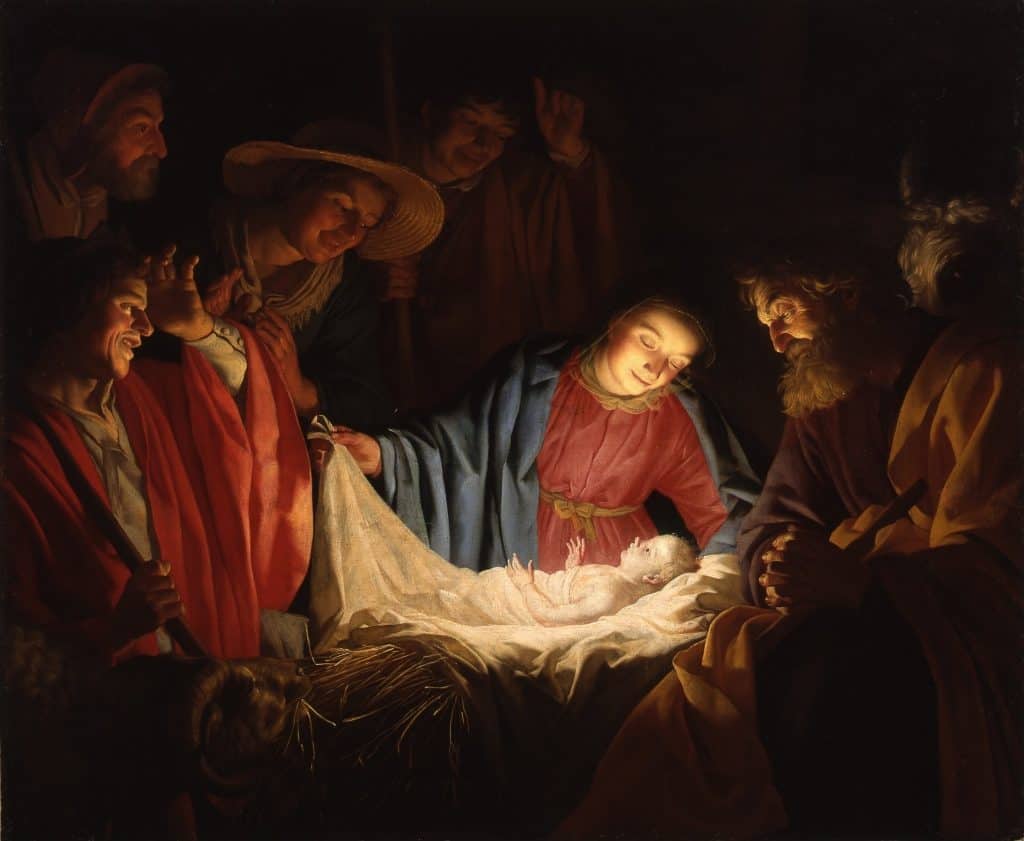
Adoration of the Shepherds by Gerald van Honthorst, 1622
Pondered. It is a wonderful word. It is the practice of casting many things together, combining them, and considering them as one. In that moment, a host of memories must have been dancing in Mary’s head. The angel’s appearance. His words. Her flight to the hill country of Judea. Elizabeth’s greeting. Their late-night conversations. The first time she noticed her tummy was rounding. Joseph’s face when he saw her. The way she felt when he believed. The whispers of neighbors. The doubts of her parents. The first time she felt the baby move inside of her. The dread of the long trip. The reality of being full-term. The first pain. The fear of having no place to bear a child. The horror of the nursery. The way it looked. The way it smelled.
The way He looked. God so frail. So tiny. So perfect. Love so abounding. Grace so amazing. Wise men bowed down. Shepherds made haste. Each memory like treasures in a box. She gathered the jewels, held them to her breast, and engraved them on her heart forever.
Soon Jesus’ mother would have even more on which to reflect—some very heavy realities, indeed.
Simeon
Mary would be called by God to endure much, and she soon would hear an aged man of God speak of her burden. The Lord had promised Simeon that he would not die before seeing God’s Anointed One. When he saw Jesus at the temple following His birth, Simeon rejoiced and declared to the Lord he was ready to “depart in peace.” He’d now seen God’s salvation, prepared for people everywhere,
“A light to bring revelation to the Gentiles,
And the glory of Your people Israel.”
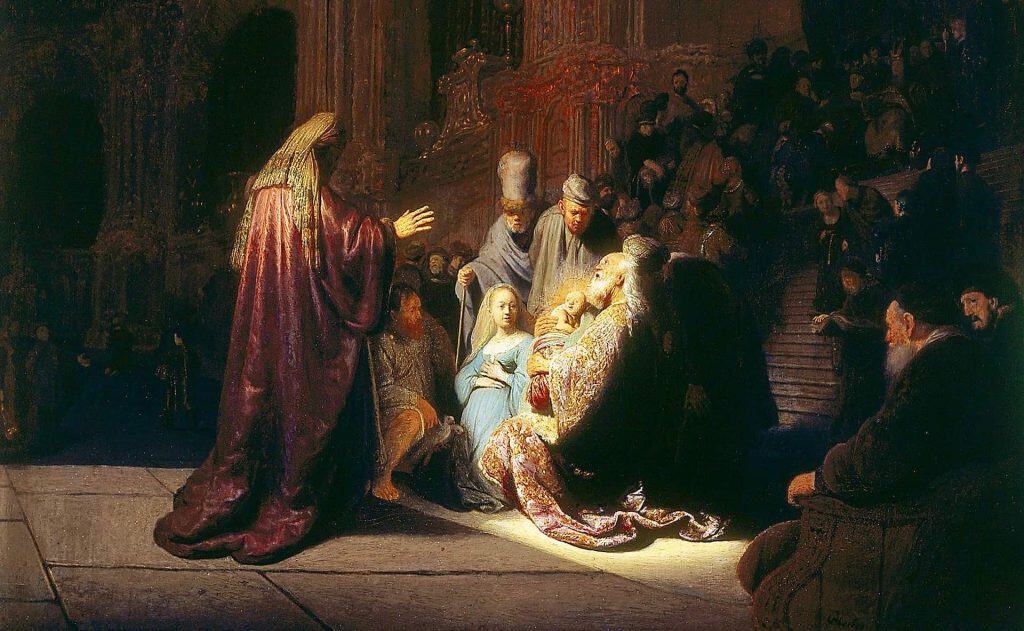
Simeon in the Temple by Rembrandt van Rijn, 1631
Mary and Joseph marveled at what was said about Him. Simeon blessed them both, but then he spoke directly to Mary. “Behold, this Child is destined for the fall and rising of many in Israel, and for a sign which will be spoken against (yes, a sword will pierce through your own soul also), that the thoughts of many hearts may be revealed.”
How would Simeon’s prophecy be fulfilled? Bible scholar John A. Martin writes,
Throughout His ministry Jesus proclaimed that the only way to the kingdom, something the nation had long sought, was to follow Him. The ones who did so would receive salvation; they would “rise.” But the ones who did not believe Him would not receive salvation; they would “fall.” These consequences would reveal what they thought about Mary’s Son.1
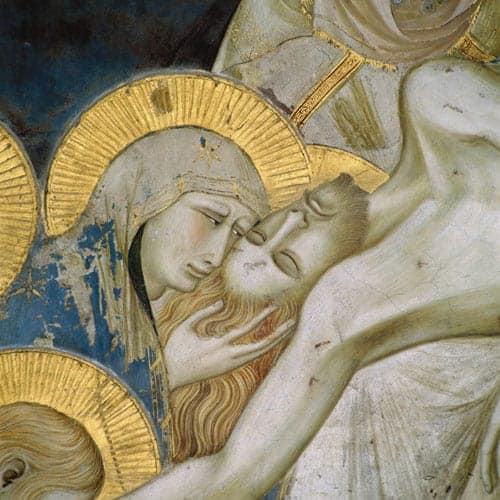
Lamentation by Pietro Lorenzetti, about 1310-1329
New Testament scholar William A. Hendricksen observes,
In a parenthesis Simeon, in addressing Mary, states that a sword would pierce her soul; in fact, as the original indicates, a large and broad sword, the symbol of intense pain, of frightful and piercing anguish. For the fulfillment see John 19:25-27.…
What Simeon said was true. But he did not see everything. He did not see that even in the midst of Mary’s sorrow she would receive a measure of comfort. At the suggestion of the crucified Savior the disciple whom Jesus loved would take her to his home. Is it not possible that the very memory of Simeon’s prophecy strengthened Mary in the moments of her deepest agony, proving to her that this too was included in God’s plan and would therefore work together for good? Best of all, because of the resurrection on the third day Mary’s sorrow would subsequently be changed to rejoicing and strengthening of faith.2
There was much that neither Mary nor Joseph understood. Yet Jesus’ parents—His mother and his father by adoption—sought to be the parents to Jesus God wanted them to be. When “they had performed all things according to the law of the Lord, they returned to Galilee, to their own city, Nazareth. And the Child grew and became strong in spirit, filled with wisdom; and the grace of God was upon Him” (vv. 39-40).
Jesus as a 12-Year Old Boy
Lightstock
The family made a pilgrimage to Jerusalem to participate in the Feast of the Passover. When Jesus was 12, Mary and Joseph discovered Jesus was missing on the journey back. Returning to Jerusalem and finding Him in the temple actively engaged with the teachers there, Joseph and Mary were amazed. Mary asked Him, “Son, why have you done this to us? Look, Your father and I have sought You anxiously” (v. 48).
Luke records, “And He said to them, ‘Why did you seek Me? Did you not know that I must be about My Father’s business?’ But they did not understand the statement which He spoke to them” (vv. 49-50).
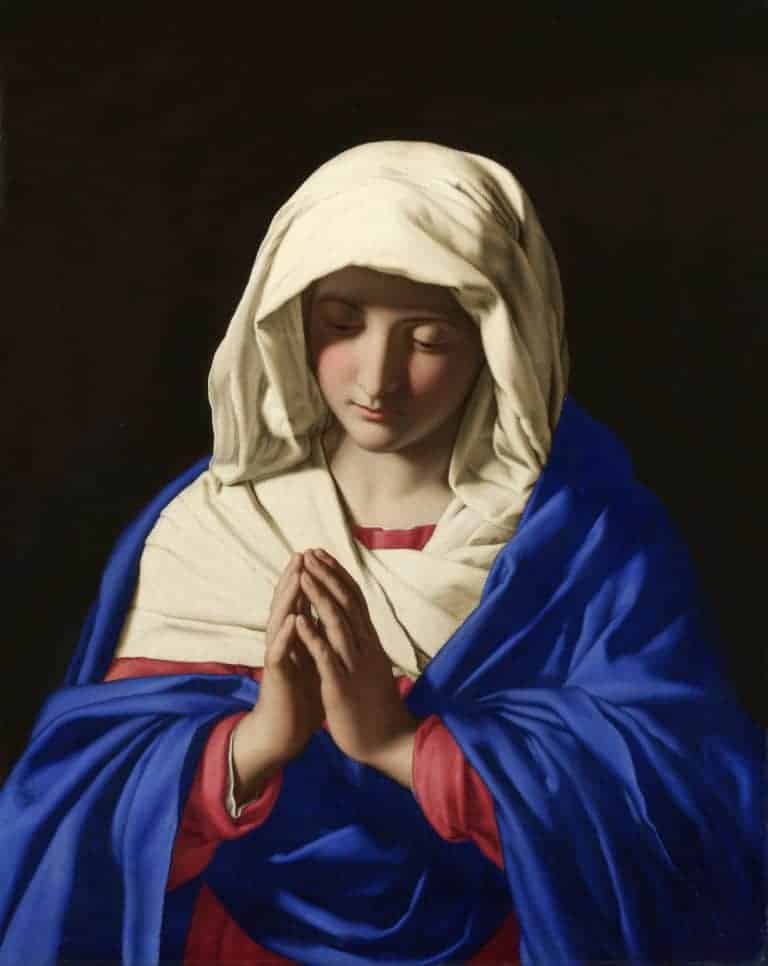
Virgin Mary by Giovanni Battista Salvi da Sassoferrato, 1640-1650
Had Mary and Joseph not been bewildered enough already, they sure were now. But the time for the beginning of Jesus’ public ministry was still years away. Scripture implies that even then, Mary would not fully understand her Son. Yet for now, He “went down with them and came to Nazareth, and was subject to them, but his mother [—again—] kept all these things in her heart. And Jesus increased in wisdom and stature, and in favor with God and man” (vv. 51-52).
Living with His parents, Jesus “increased in wisdom and stature, and win favor worth God and man” (Luke 2:52).
It’s important to understand that we cannot be faithful to the Scriptures and attribute any divine characteristics to Mary. She was a sinner in need of a Savior like every other human being. Yet she was God’s instrument to bring Jesus into the world and to provide the nurture and assistance only a mother could provide. God needed her in this sense, and He used her to accomplish these wonderful purposes.
Mary was God’s instrument to bring Jesus into the world and to provide the nurture and assistance only a mother could provide.
Next time, we’ll consider Joseph. As a man and as Jesus’ adopted father, he was well-equipped to protect and provide for his family. And he did these very things in this real-life, cliffhanger drama.
Go here for summaries of all the articles in this series.
Copyright © 2017 by B. Nathaniel Sullivan. All rights reserved.
Unless otherwise noted, Scripture passages are taken from the New King James Version®. Copyright © 1982 by Thomas Nelson. Used by permission. All rights reserved.
Scripture passages marked NIV or New International Version are taken from The Holy Bible, New International Version®, NIV® Copyright © 1973, 1978, 1984, 2011 by Biblica, Inc.® Used by permission. All rights reserved worldwide.
Notes:
1John A. Martin, “Luke” in The Bible Knowledge Commentary, New Testament edition, John F. Walvoord and Roy B. Zuck, eds., (Victor Books, 1983), 209.
2William Hendriksen, The Gospel of Luke, (Grand Rapids: Baker Book House, 1978), 170, 171.
top image: Holy Family with Bird, c. 1650, by Bartolomé Esteban Murillo
Comments (0)