
A Lesson From History
The Supreme Court Has Been Wrong Before
If the Supreme Court’s Dred Scott opinion had been meekly accepted, America would truly have ended her experiment in ordered liberty.
—William J. Bennett1—
On Friday, March 6, 1857, the Supreme Court of the United States issued its ruling in the Dred Scott v. Sandford case. One of several questions before the court had been whether or not slavery would be permitted in the western territories. The Missouri Compromise, which became law in 1820, directed that all the territories north of latitude 36°30′ and west of Missouri would be free.2 Later, the Compromise of 1850 established that the people residing in the territories could decide the question of slavery by voting. Understandably, however, people on both sides of the issue remained passionate; and in Kansas in 1854, the process turned violent. Would the Supreme Court at last be able to settle the issue that countless deliberations in Congress had failed to resolve?3

Dred Scott
Dred Scott was a principal individual in the case. A slave, he was owned by doctor in the United States Army. The doctor had lived in the free state of Illinois and the free territory of Wisconsin and had taken Scott with him to those places. Scott sued for his freedom. While a lower federal court ruled him to be a citizen, the Supreme Court overturned that decision.4 Chief Justice Roger B. Taney wrote the majority opinion for the court, which ruled 7-2 against Scott.5 It was a breathtaking and far-reaching decision we will not be able to explore in depth here, but we’ll “hit the high spots” and cover enough information to make obvious the outrageous nature of the ruling.
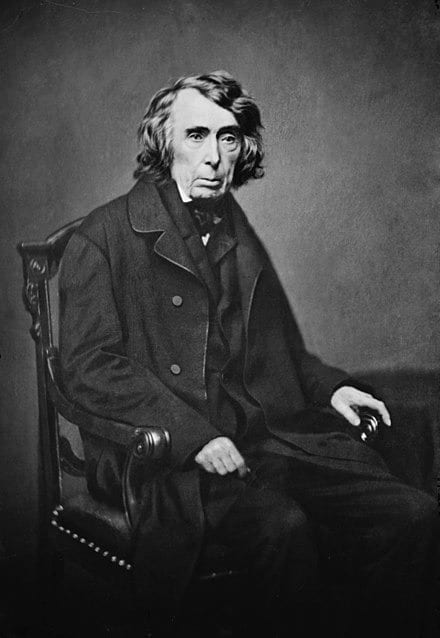
Roger B. Taney
According to the court, blacks could never become citizens of the United States.6 Scott had remained a slave in both Illinois and Wisconsin, the court said, because the United States Constitution did not consider him to be a person, but rather property.7 This notion stood in sharp contrast to history, because in 1787, free blacks were indeed part of the U.S. population.8 The ruling also struck down the Missouri Compromise as unconstitutional, thereby establishing slavery in all U.S. Territories.9 It is clear that “Taney and the other justices were attempting to halt further debate on the issue of slavery in the territories. The decision inflamed regional tensions, which burned for another four years before exploding into the Civil War.”10
Southerners generally applauded the decision, but the court had engaged in a blatant overreach, and Northern opposition was intense. Taney actually had written that the Constitution’s framers held that blacks “had no rights which the white man was bound to respect; and that the negro might justly and lawfully be reduced to slavery for his benefit.”11 William J. Bennett writes, “Far from settling the slavery question, Taney’s Dred Scott ruling inflamed opposition to the extension of slavery. It served as the greatest recruitment tool for the new Republican Party.”12 Three years later, Abraham Lincoln would become the first Republican to win the presidency.
Here’s another description of the opinion from both historical and practical points of view: It “was a major political miscalculation. In its ruling, the court sought to solve the slavery controversy once and for all. Instead, the court intensified sectional strife, undercut possible compromise solutions to the issue of slavery’s expansion, and weakened the moral authority of the judiciary.”13
In May of 1857, just weeks after the Supreme Court issued its ruling, Frederick Douglass delivered a speech about the decision. Douglass was an African-American abolitionist and a speaker, writer, and articulate defender of the U.S. Constitution. Said Douglass,
You will readily ask me how I am affected by this devilish decision—this judicial incarnation of wolfishness? My answer is, and no thanks to the slaveholding wing of the Supreme Court, my hopes were never brighter than now.
I have no fear that the National Conscience will be put to sleep by such an open, glaring, and scandalous tissue of lies as that decision is, and has been, over and over, shown to be.
The Supreme Court of the United States is not the only power in this world. It is very great, but the Supreme Court of the Almighty is greater. Judge Taney can do many things, but he cannot perform impossibilities. He cannot bale out the ocean, annihilate the firm old earth, or pluck the silvery star of liberty from our Northern sky. He may decide, and decide again; but he cannot reverse the decision of the Most High. He cannot change the essential nature of things—making evil good, and good evil.
Happily for the whole human family, their rights have been defined, declared, and decided in a court higher than the Supreme Court. “There is a law,” says [Lord Chancellor Henry Peter] Brougham, “above all the enactments of human codes, and by that law, unchangeable and eternal, man cannot hold property in man.”14

Frederick Douglass
The Supreme Court of the United States is…very great, but the Supreme Court of the Almighty is greater. Judge Taney can do many things, but he cannot perform impossibilities.…He cannot change the essential nature of things—making evil good, and good evil.
The words of Frederick Douglass ring true yet today, and it is utterly amazing just how many of his statements apply directly, not only to Dred Scott, but also to another illegal and illegitimate decision made by the Supreme Court, Obergefell v. Hodges. In his day, Douglass stood in the prophetic tradition of boldly asserting the ultimate standard of right and wrong to expose the folly of tyranny—judicial and otherwise. This is exactly what we must do now, in 2015, with regard to the court’s recent redefinition of marriage nationwide.
Accordingly, on October 8, 2015, over 60 legal scholars released a statement urging public officials and citizens to resist the tyranny and judicial activism imposed by the five Supreme Court Justices who arbitrarily redefined marriage in the United States to include same-sex couples.15 Next time, we will explore some of the key points of that important statement.
Part 2 is available here.
Copyright © 2015 by B. Nathaniel Sullivan. All Rights Reserved.
Updates
Forgiveness and Reconciliation for our Times
BreakPoint Commentary for March 13, 2017
From a descendant of Roger Taney to a descendant of Dred Scott: I’m Sorry
Washington Post article, March 6, 2017
Statement Calling for Constitutional Resistance to Obergefell v. Hodges
Notes:
1William J. Bennett, America, The Last Best Hope, Volume 1: From the Age of Discovery to a World at War, (Nashville: Thomas Nelson, 2006), 294.
2http://www.britannica.com/event/Dred-Scott-decision
3http://www.history.com/this-day-in-history/dred-scott-decision
4http://www.socialstudiesforkids.com/wwww/us/dredscottdecisiondef.htm
5http://www.britannica.com/event/Dred-Scott-decision
6http://www.socialstudiesforkids.com/wwww/us/dredscottdecisiondef.htm
7,8http://www.history.com/this-day-in-history/dred-scott-decision
9http://www.pbs.org/wgbh/aia/part4/4h2933.html
10http://www.history.com/this-day-in-history/dred-scott-decision
11https://en.wikipedia.org/wiki/Roger_B._Taney
11William J. Bennett, America, The Last Best Hope, Volume 1: From the Age of Discovery to a World at War, (Nashville: Thomas Nelson, 2006), 295.
12http://www.history.com/this-day-in-history/dred-scott-decision
13http://www.digitalhistory.uh.edu/disp_textbook.cfm?smtID=3&psid=293
14http://blogs.baruch.cuny.edu/americanliteratureifall09/frederick-douglass-on-the-dred-scott-decision/; also see http://teachingamericanhistory.org/library/document/speech-on-the-dred-scott-decision-2/
Comments (0)