The Foundation and Benefits of Absolute Truth
True Liberty Is Grounded in a Recognition of Absolute Truth
There are three points of doctrine the belief of which forms the foundation of all morality. The first is the existence of God; the second is the immortality of the human soul; and the third is a future state of rewards and punishments. Suppose it possible for a man to disbelieve either of these three articles of faith and that man will have no conscience, he will have no other law than that of the tiger or the shark. The laws of man may bind him in chains or may put him to death, but they never can make him wise, virtuous, or happy.
—John Quincy Adams—
[N]either the wisest constitution nor the wisest laws will secure the liberty and happiness of a people whose manners are universally corrupt. Here therefore is the truest friend to the liberty of his country who tries most to promote its virtue, and who, so far as his power and influence extend, will not suffer a man to be chosen into any office of power and trust who is not a wise and virtuous man.
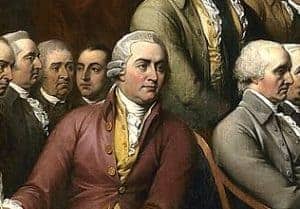
—Samuel Adams, pictured above in John Trumbull’s Declaration of Independence—

Freedom prospers when religion is vibrant and the rule of law under God is acknowledged.
—Ronald Reagan—
View summaries of all the articles in this series here.
A Jewish rabbi bound on a plane for Israel soon discovered he was seated next to one of the leaders of Israel’s socialist labor movement. After the plane became airborne, a student of the rabbi who was seated several rows behind him approached him and offered him his slippers. “Here are your slippers, sir,” he said, “You’ll feel more comfortable in them, since your feet swell terribly on the plane.” A short time later the same young man came forward again and offered the rabbi several sandwiches. “Your wife fixed these for your lunch, sir. We know you’ll like them much better than the food the airline will offer.”
These were not isolated incidents, but a pattern; the student returned on numerous occasions to check on the rabbi, to offer him something to make his flight more pleasant, or to serve him in some other way. All of this made quite an impression on the socialist leader, who finally turned to his seatmate and said, “Wow! I’m so impressed with your son! I have four grown sons, and never in all my life have they offered to serve me as your son has waited on you. Why is he so attentive to you?”
“I have to be honest with you,” said the rabbi. “This young man is not my son but my student. His service, as good as it is, is nothing compared to the assistance my own son would give me if he were here.
“The reason the members of the next generation, including members of our own families, treat us as they do is quite simple. All of them are living according to the ideas and principles we’ve taught them. You decided some time ago to tell them that you—and they—descended from apes, and this is what you taught them. They know intuitively this means that you are one generation closer to being a monkey than they are, so it’s only natural that they would expect you to serve them. I, on the other hand, have taught my children and students that we have been created by God Himself. They understand this puts me one generation closer to the Source of Ultimate Truth, and they treat me in accord with this understanding. We reap what we sow.”1
Of course, just as the socialist leader’s belief in evolution does not prove God doesn’t exist, neither does the rabbi’s belief in divine creation prove that He does. What our story does demonstrate is that a belief in God is conducive to civil behavior, and ultimately to a civil society. It also sets the stage for us to see that true freedom can exist only in a society grounded in virtue. Without virtue, freedom unravels into chaos, which leads to bigger government and, finally, to tyranny.
Consider the positive virtues inherent in the rabbi’s perspective. A belief in being created by God helps a person to cultivate a variety of noble qualities in his or her life, including these.
- Generosity
- Gratitude
- Selflessness
- Humility
- A sense of responsibility
- A sense of accountability
- Respect for others
- Respect for one’s elders
- Respect for one’s peers, grounded in the truth that all of human life is valuable because God creates it in His image
And to think—we got all this just from considering the implications of the rabbi’s observations on the plane!
Yet there’s more. While selfishness and pursuit of personal pleasure tend to foster distrust and tension in relationships, the virtues listed above promote numerous priceless benefits, including stronger and more fulfilling relationships and a greater sense of fulfillment and happiness.
On a societal level as well, virtues establish and maintain order and stability. A virtuous people exercise a positive self-restraint that makes true freedom in society possible. The other side of the coin is that without virtue, self-restraint is non-existent as well. Without self-restraint, chaos, then tyranny, inevitably follow.
 Virtue, let us not forget, flourishes in the soil of a belief in God and an awareness of one’s accountability to Him. A belief in absolute truth also is a part of this mix. To be accountable to God means to understand that He holds us to a high and unchanging standard—His. If this makes you feel straight-jacketed and unfairly confined, think of a train, which has been designed and built to travel along railroad tracks. The train constructed neither itself nor the tracks. Human beings built both of these for a purpose. The train accomplishes its purpose when it runs on the tracks that fit its design.

In like manner, God designed people for a purpose that ultimately can be fulfilled only when they are aware of their accountability to Him. Yes, this is confining in some ways, but it is liberating in many more.
The rabbi is right. So are the statesmen we’ve quoted at the top. And so is Founding Father Fisher Ames, who said, “The happiness of a people, and the good order and preservation of civil government, essentially depend on piety, religion, and morality.”
Let us do all we can to help our society rediscover and re-implement this principle. Once again, absolute truth is far more liberating than confining when we cooperate with it. Why? Because it is part of the uncompromising, unyielding, unbending, real world in which we live. Reality isn’t mean, it just is. Because it is what it is, it will hit you in the face if you try to defy it.
Part 5 is available here.
Copyright © 2017 by B. Nathaniel Sullivan. All rights reserved.
1Rabbi Daniel Lapin, America’s Real War: An Orthodox Rabbi Insists that Judeo-Christian Values Are Vital for Our Nation’s Survival, (Sisters, OR: Multnomah Publishers, 1999), 51-52.
Comments (0)