A half-truth masquerading as the whole truth becomes a complete untruth.
—J. I. Packer—
Key point: Influential pastor J. D. Greear recently posted an article on his blog titled “Three Ways We [in the Church] Go Wrong When Discussing Homosexuality.” Greear himself went wrong, however, in numerous statements he made in his article. It is vital that Christians understand Greear’s errors so they can know the truth themselves and share it with others.
This is part 1 of a 2-part series. You’ll be able to access part 2 at the end of this article.

James David “J. D.” Greear
James David—J. D.—Greear, 46, is the pastor of the multi-campus Summit Church in North Carolina, a church that sees almost 10,000 in attendance every week. Greear also is the president of the Southern Baptist Convention, having been reelected to a second one-year term at the SBC’s annual meeting in June of this year in Birmingham, Alabama. J. D.’s influence is great, so if he gets something wrong, many people will be potentially confused and/or misled.
On January 27, 2019, Greear preached a sermon on Romans 1:24-32. He titled it “How The Fall Affects Us All.” We expressed a major concern about this sermon in an earlier post, even though Greear’s sermon wasn’t the main focus of our article. Significantly, numerous statements in the sermon drew criticism (also go here), and rightly so. As you might expect from the title, Greear emphasized that in Romans 1:24-32 and the verses surrounding it, Paul paints a picture of what rebellion against God looks like—a rebellion, Greear says, that is common to all people, everywhere. The pastor and Southern Baptist Convention president asserted that Paul even was writing about himself.
I do not doubt that Greear sincerely believes this is what the Scripture teaches. Yet in a sense, with this interpretation he has more leverage to preach against pride and certain other sins named in these verses and to avoid focusing on the uncomfortable topic of homosexuality. If all people are equally rebellious, then anyone who points out specific sins can be accused of not pointing first to himself. If you think other people stand guilty before God, then look in the mirror! After all, pride, or being “arrogant” and “boastful” — is one of the sins Paul names!
One doesn’t have to believe that everyone is a part of this group of rebellious sinners, though, to understand that he or she must avoid pride. While all are sinners and have rebelled against God, this passage is not saying that all have been equally rebellious. Everyone needs God’s grace and forgiveness, but not everyone has “suppress[ed] the truth in unrighteousness.” The apostle was writing about a specific group of people who have descended so far into depravity that “God gave them over in the lusts of their hearts to impurity, so that their bodies would be dishonored among them.” (Romans 1:18,24).

Jon Harris
Theologian and video blogger Jon Harris offers his take on Greear’s sermon in this podcast. Using biblical evidence, Harris contends strongly that Paul was not talking about all people in Romans 1, but about people who had defiantly rejected core truths they innately knew. As a result, they were, and are, spiraling downward into deep perversion. Hear Harris make his case in this audio clip from his podcast. Keep his interpretation in mind as you continue to read. While we won’t examine Greear’s sermon, we will discuss statements he made in an article based on it. Harris’s interpretation will help you see why Greear tends to be harder on the church than you might expect, and softer on the sin of homosexuality (even though the Summit Church pastor does acknowledge that homosexual activity is a sin.)
Doubling Down
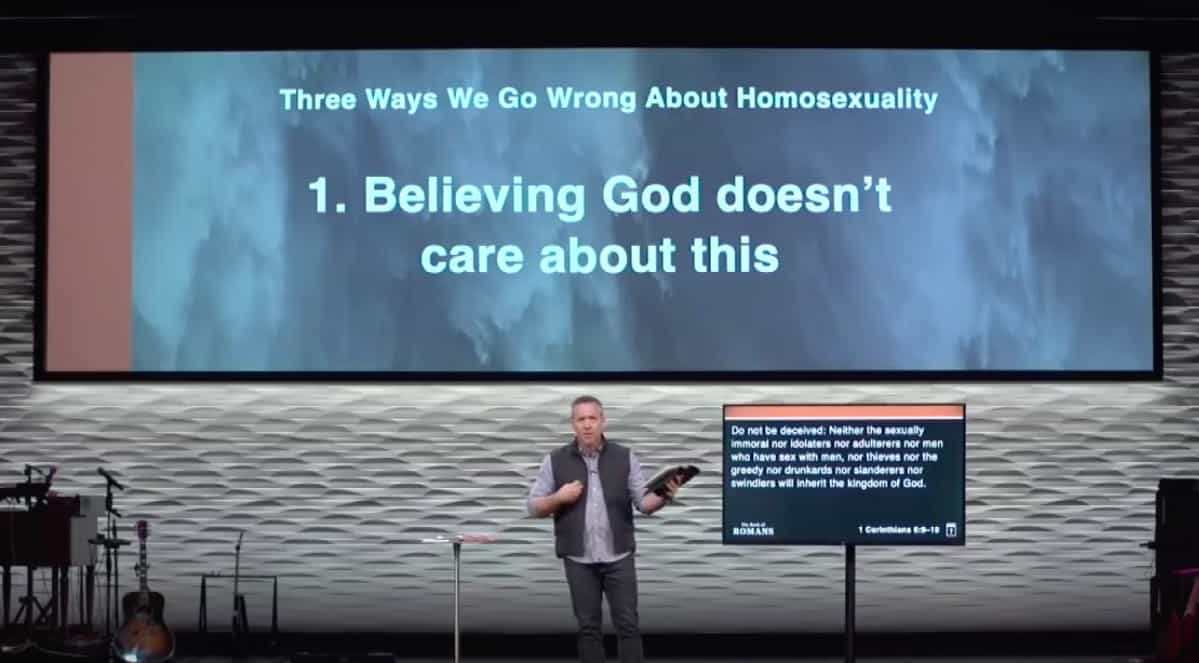
Fast forward seven months. On Wednesday, August 28, 2019, Greear posted an article on his blog titled “Three Ways We Go Wrong When Discussing Homosexuality.” In doing so, he essentially doubled down on the assertions he made in his sermon. His article carries the same content his January sermon did, although it was, of necessity, streamlined.

Like his sermon, Greear’s post offers many true statements. In the mix, however, are some dangerous implications, falsehoods, and half-truths. Six items stand out. We’ll consider these in the order in which they appear in the post—three this time and the remaining three next time. Be forewarned! Things are not totally as Greear presents them.
The Church’s “Failure”
Item one: Greear goes wrong when he maligns the church for not dealing with the subject of homosexuality effectively through the years, and when he accuses the church of not caring about those experiencing same-sex attraction.
The pastor begins his article by writing,
Historically, we in the church haven’t done a great job in conversations about homosexuality, and we’ve done an even worse job caring for those experiencing this.
He says this without offering any evidence whatsoever. Video blogger A. D. Robles challenges Greear on this point.

A. D. Robles
This is a weird article.…So, it starts off—it says, “Historically, we in the church haven’t done a great job in conversations about homosexuality, and we’ve done an even worse job caring for those experiencing this.”…I find this to be one of the most annoying things. People always say stuff like this, and they just expect you to believe it. They don’t ever have to prove it. It’s like—Well, the church is horrible about talking about race.…And it’s like, well, OK,…but prove it! I don’t believe this for a second, that the church has done a terrible job treating or caring for people that experience homosexuality. I don’t believe it. And actually, his article itself, proves that this is just not the case. He talks about Rosaria Butterfield, and how an RPCNA [Reformed Presbyterian Church of North America] minister led her to Christ. Obviously this guy knew how to do it! And he obviously learned it from somewhere. So people have been talking about the right way to talk about homosexuality for a very long time. The RPs have put out a great statement on sexuality a long time ago. They’ve been doing this for a long time. So this whole idea—people love doing this. They’re just ripping the church. They’re terrible at this. They’re terrible at that. They’re on the wrong side of history here.…I find that so annoying. Anyway….
I’m sure A. D. would not try to make the case the church has done a perfect job with regard to the issue of homosexuality, but to malign it for having done a bad job “historically” — J. D.’s term — is unfair.
Former homosexual Becket Cook, whom we will hear from momentarily, was converted to Christ at a church service. He had been invited to church by some Christians he met in a coffee shop in LA. In an informal conversation with them in which they shared the gospel, Becket asked what they believed about homosexuality. They told him, forthrightly, they believed it is a sin. On the Eric Metaxas show on August 8, Becket told his story and said that while a few years before he likely would have responded angrily, he appreciated their honesty and frankness. They didn’t beat around the bush or go out of their way not to offend, yet they also were engaging and friendly as well.
I fear that today, many churches actually may be doing a much poorer job of really caring about and helping homosexuals than the church historically did when it spoke frankly about homosexuality as a sin. Authentic love, grace, and compassion must be on display, of course; and we must understand some key truths about homosexuality and the mind-set of many homosexuals today.
That said, true compassion never will ignore the truth. In fact, it always will find ways to share it. As evangelist Ray Comfort has said, “How much do I have to hate homosexuals to lie to them about what the Bible says?” While I’m not accusing J. D. Greear of deliberately lying, I believe he is misled and is misleading people—often subtly—on this issue.
The Summit Church / You Tube
Lost to Saved—What Does that Mean?
Item two: Greear goes wrong when he fails to explain that for the man or woman who’s been involved in homosexuality, moving from being spiritually dead to being spiritually alive includes moving toward heterosexuality.
Greear makes a true statement, but one that he fails to sufficiently explain. He writes,
Possessing a desire innately [to sin] just shows us that we have corrupt hearts and we need to be born again. The gospel message is not “Let the gay become straight” but “Let the dead—and that’s all of us—become alive.”
Ravi Zacharias (disclaimer) put it this way, “Jesus Christ did not come to make bad people good, but to make dead people alive.” Greear and Zacharias are right, and so are a great many Christians who’ve come out of homosexuality when they explain the transformation they’ve experienced. Many times you will hear them say, “It’s not Gay to Straight. It’s Lost to Saved.”
Again, they’re right—but more needs to be said. More must be said. If we’re not careful, we will leave the impression that a Christian can remain involved in homosexuality. Such is not the case.
When a person who’s been involved in homosexuality moves from lost to saved, where does that put him or her in terms of homosexuality and other sinful habits and desires?
-
-
- Paul wrote, “Therefore if anyone is in Christ, he is a new creature; the old things passed away; behold, new things have come” (2 Cor. 5:17).
- He also said, “[D]o you not know that the unrighteous will not inherit the kingdom of God? Do not be deceived; neither fornicators, nor idolaters, nor adulterers, nor effeminate, nor homosexuals, nor thieves, nor the covetous, nor drunkards, nor revilers, nor swindlers, will inherit the kingdom of God. Such were some of you; but you were washed, but you were sanctified, but you were justified in the name of the Lord Jesus Christ and in the Spirit of our God” (emphasis added; 1 Cor. 6:9-11).
-
In the life of a new Christian, do all the desires and temptations to sin go away? They do not. Yet overshadowing them in a grand and refreshing way is the new life Christ has given.
-
-
- “So then, brethren,” Paul wrote in Romans 8:12-13, “we are under obligation, not to the flesh, to live according to the flesh — for if you are living according to the flesh, you must die; but if by the Spirit you are putting to death the deeds of the body, you will live.”
- The apostle also commanded, “Therefore I urge you, brethren, by the mercies of God, to present your bodies a living and holy sacrifice, acceptable to God, which is your spiritual service of worship. And do not be conformed to this world, but be transformed by the renewing of your mind, so that you may prove what the will of God is, that which is good and acceptable and perfect” (Rom. 12:1-2).
-
Another way a person who came to Christ out of homosexuality might describe the Lord’s call on his or her life is this: “God doesn’t call me to heterosexuality, but to holiness.” Here we must wave a red flag. Wait a minute! Make sure you don’t let your understanding of God’s call pave the way for you to make excuses to sin or to flirt with temptation!
-
-
- We never would say God doesn’t call a thief-turned-Christian to be productive and generous, but to holiness.
- We never would say that God doesn’t call a liar-turned-Christian to tell the truth, but to holiness.
- Nor would we ever say that God doesn’t call a murderer to cease killing people, but to holiness.
-

Becket Cook, author of A Change of Affection: A Gay Man’s Incredible Story of Redemption
Why? We understand intuitively that in each of these instances the God-honoring activity is a part of holiness. (See Eph. 4:17-32.) Because heterosexuality is a part of God’s good design, it also is a part of holiness. Therefore, the call to holiness for the Christian with homosexuality in his or her past involves heterosexuality—or at least moving toward it. At bare minimum, this means renouncing homosexuality as an identity and turning away from homosexual activity altogether.
Because heterosexuality is a part of God’s good design, it also is a part of God’s call to holiness for every believer.
This quite likely will involve a struggle. Some may struggle with same-sex attraction for some time, or even until the day they die, but the power of Christ is real and effective. Just ask Becket Cook. As we mentioned earlier, he shared his testimony on the Eric Metaxas show on August 8, 2019. You can hear a brief portion of that program here.
I knew in that moment [of my conversion to Christ] that being a gay man was no longer who I was, and that that wasn’t going to be a part of my life anymore. I just knew instantly. I knew in the core of my being that that was not my identity anymore.
—Becket Cook, author of A Change of Affection: A Gay Man’s Incredible Story of Redemption—
The Elusive Search for a “Gay Gene”
Item three: Greear goes wrong when he implies homosexuals are “born that way.”
Pastor Greear writes,
If someone says, “But I was born this way,” I don’t dispute that. But possessing a desire innately doesn’t make it right.”
The last sentence is correct, but in the first, Greear, however unintentionally, perpetuates the myth that a gay gene exists or that homosexuals are genetically “hardwired.” Science never has discovered a “gay gene,” and a recent extensive study shows no likelihood that it ever will. (The BBC was among numerous outlets reporting on this. So was the gay-aligned pinknews and the pro-family group the American Family Association). While news of this particular study came out immediately after Greear posted his article, it has been widely known for many years (despite perceptions and myths) that no evidence exists for a “gay gene.” (Go here and here.) J. D. Greear has no excuse for misleading people on this point—even if he was focused on making another point that was fully true.
Stay Tuned!
In a few days, we’ll continue reviewing the items on our list. Even though our list isn’t exhaustive, we’ll cover three more assertions, for a total of six.
We’ll continue raising warning flags and sounding the alarm—because we need to!
Be sure to return!
This has been part 1 of a 2-part series. Part 2 is available here.

Copyright © 2019 by B. Nathaniel Sullivan. All rights reserved.
Unless otherwise indicated, Scriptures in this article have been taken from the NEW AMERICAN STANDARD BIBLE®, Copyright © 1960, 1962, 1963, 1968, 1971, 1972, 1973, 1975, 1977, 1995 by The Lockman Foundation. Used by permission.
top image credit: Lightstock
Comments (0)