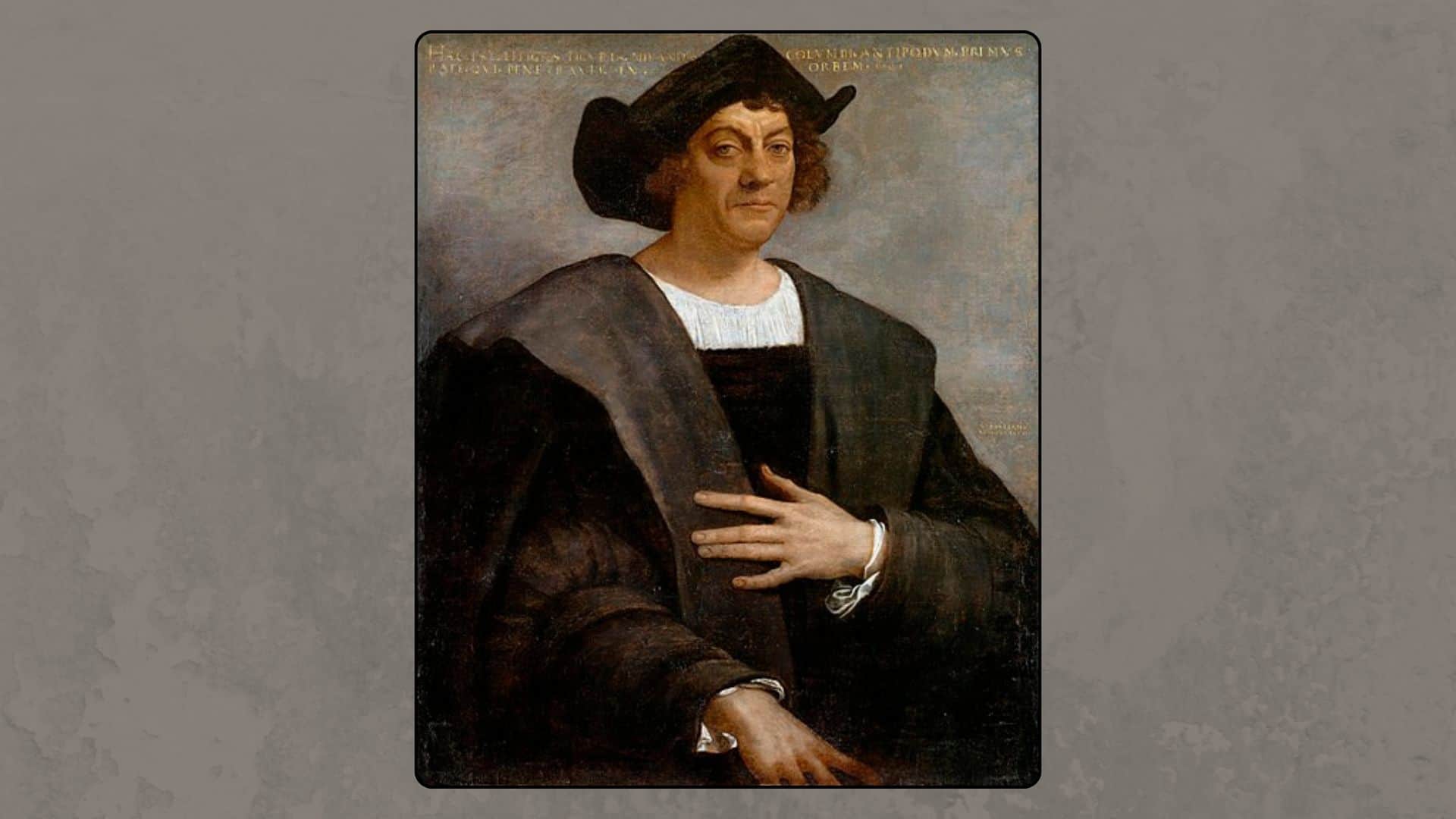
It was the Lord who put into my mind (I could feel His hand upon me) to sail to the Indies. All who heard of my project rejected it with laughter, ridiculing me. There is no question that the inspiration was from the Holy Spirit, because He comforted me with rays of marvelous illumination from the Holy Scriptures.…Our Lord Jesus Christ desired to perform a very obvious miracle in the voyage to the Indies….
—Christopher Columbus, about a decade after his most famous voyage1—
Go here for additional articles about Christopher Columbus and Columbus Day.
In commemoration of Columbus Day, I have gleaned from several different sources information that refutes the prevailing narrative regarding Christopher Columbus and the impact of his voyages on America and Americans, even to this day. Any honest observer can only conclude that the prevailing narrative is being used to push an anti-American, socialist, and globalist agenda. We must be wary of this and not be taken in by simplistic interpretations of history. History always is and forever will be complex and nuanced; we must understand it in light of the times and cultures of the past, not our own, present-day cultural standards.
Let us also never forget that Karl Marx made the following statements (see the discussion under Principle 9 in this article). Marx was wrong about a great many things, but not about manipulating people by divorcing them from their history and heritage.
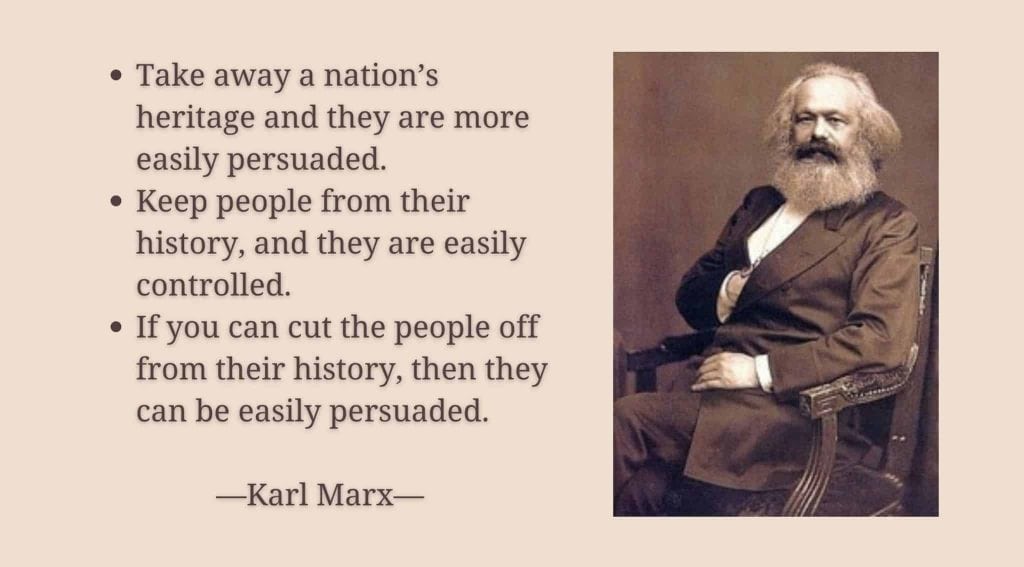
Why Are Leftists So Outraged Over Columbus?
In their book, What if the Bible Had Never Been Written? D. James Kennedy and Jerry Newcombe write,
 Of all the Spanish and Portuguese explorers of note, Christopher Columbus was the most significant. He was a man influenced by the Bible more than most people know.
At about eight o’clock on the morning of October 12, 1492, Christopher Columbus struggled out of the surf onto the Western Hemisphere, and thus a new world was born. Desmond Wilcox, author of Ten Who Dared, writes this of Columbus:
The voyage of Columbus…was conceptually breathtaking. It had long been known the the world was a sphere, but sailing around it was a startling idea that only a few years earlier would have been unthinkable. Columbus was an inspired purveyor of ideas as well as a splendid seaman, and he readily synthesized all the information at hand not a patten that established that China lay some 3,000 miles due west of Europe. If he had known that the distance was really 12,000 miles, perhaps he would never have set sail; certainly his crew wouldn’t have gone.2
Until a hundred years ago, there was worldwide adulation for this feat. All of Europe and the Americas held the discoverer of the New World in the highest esteem. There are more cities and lakes and parks and other places in this country (and in the Americas) named after Columbus than any other human being.…
But nowadays, something is different.3
Why is Columbus being so maligned? Kennedy and Newcombe explain:
In the past hundred years, we have seen the rise of atheism, skepticism, communism, fascism, socialism, and every other kind of “ism” opposed to the Word of God — whose proponents hate God and Christ and Christianity. These people are determined to refashion America in their image — in their unbelieving, ungodly, or pagan image. But to do so, they have to move this nation off its Christian foundations.4
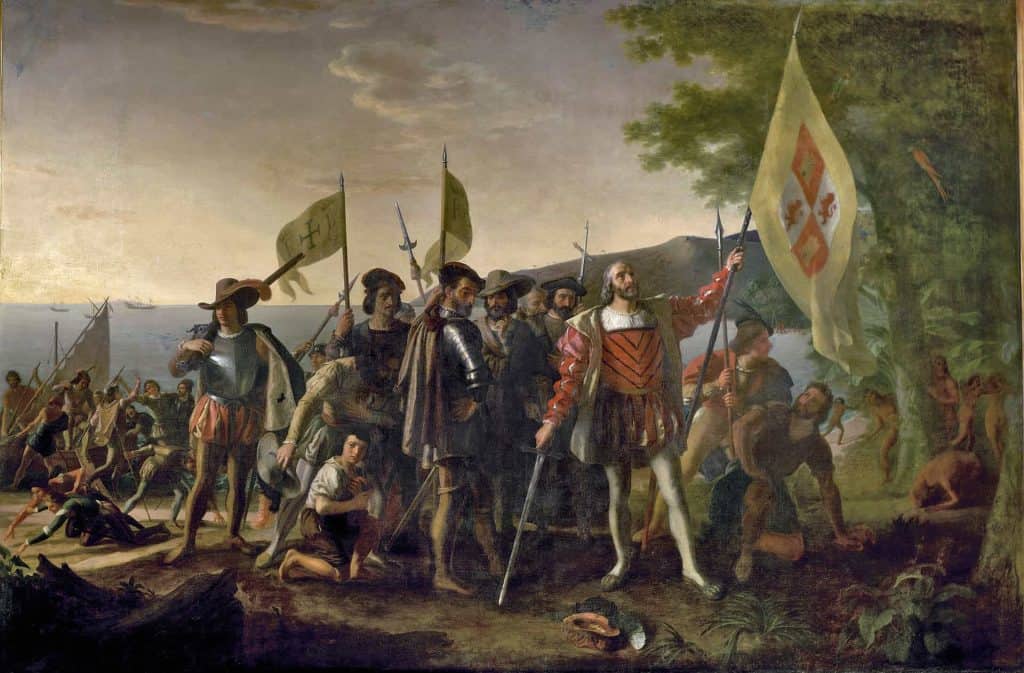
Landing of Columbus at the Island of Guanahaní, West Indies (1846), by John Vanderlyn
The authors go on to acknowledge, and they do so without hesitation, that Christopher Columbus was flawed and imperfect, as all of us are. Even so, “He cannot be blamed for the things the modern critics would like to dump upon him.”5 If Columbus
brought disease to the Western world, which the sailers and the settlers [indeed] did, we must realize that the people living at that time had no understanding of the germ theory of disease. [Historian William Bennett has also effectively made this point in his work.] By the way, it is never mentioned that the explorers also carried back to Europe New World diseases that decimated Europe. [Author of Columbus and Cortez, Conquers for Christ John] Eidsmoe [writes] that if Columbus is to be blamed for the shortcomings of Western culture, the he also must be given some of the credit for its achievements.6
Kennedy and Newcombe continue. They quote Eidsmoe, who writes,
Let us credit [the Europeans] for their achievements and contributions: art, music, architecture, ethics, liberty, law, government, a Constitution that has served as a model across the world, an economic system that has produced the greatest good for the greatest number and the highest level of prosperity the world has ever known, and a spirit of ingenuity and achievement that led to unparalleled medical and technological advances.7
Historian Alvin Schmidt writes of Columbus that while
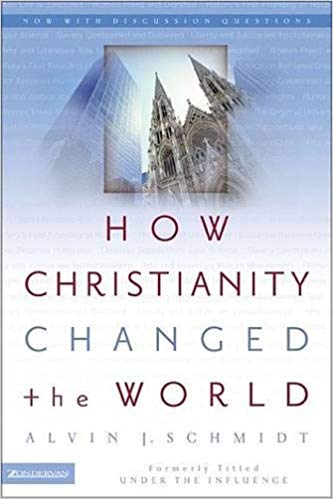 he certainly was economically motivated to undertake his venture, his being a Christian also played a major role.…Columbus was a man with strong Christian convictions, something that is not generally known.…This Christian man’s determination, which resulted in his discovering the New World, produced sea-change effects for the entire world. The discovery extended the geographic scope of Christianity as many American Indians were converted. And although European diseases and geographic dislocations, along with many immoral acts committed by some of Columbus’s men and later by the Conquistadors, took heavy tolls on native inhabitants, the overall contributions that resulted from the discovery of America are still benefiting the world in a wide variety of ways.8…
In a number of instances,…harsh criticisms [of Columbus] have spawned protest speeches in the United States in recent years, most commonly around Columbus Day (October 12), a federal holiday. [Schmidt’s book was first published in 2001, with a revised edition published in 2004.] The protests are often initiated by the American Indian Movement (AIM) and its sympathizers; yet no members of AIM have ever stated that they would like to return to the primitive cultural practices that existed among the American Indians before Columbus arrived — an event that opened the doors to immigrants and their ensuing ideas that produced myriad cultural and technological conveniences, that, for the most part, even the protesters seem to enjoy.9
Informative Videos That Give The Real Story About Christopher Columbus and Columbus Day
Notes:
1Christopher Columbus, The Book of Prophecies, quoted in John Eidsmoe, Columbus and Cortez, Conquers for Christ: The Controversy, The Conquest, The Mission, The Visions (Green Forest, AR: New Leaf Press, 1992). Eidsmoe’s quotation from Columbus is cited on page 76 of What if Jesus Had Never Been Born? by D. James Kennedy and Jerry Newcombe (Nashville: Thomas Nelson Publishers, 1994). Kennedy and Newcombe introduce the quote from Columbus by writing, God’s “hand can even be sen in leading some of the courageous explorers who opened up the New World. For example, Christopher Columbus saw his voyage as fulfillment of what Isaiah had prophesied about the heathen turning to the true God. About a decade after his expedition, he wrote:….”
2Desmond Wilcox, Ten Who Dared (Boston: Little, Brown and Company, 1977), 13; quoted in D. James Kennedy and Jerry Newcombe, What if the Bible Had Never Been Written? (Nashville: Thomas Nelson Publishers, 1998), 176.
3D. James Kennedy and Jerry Newcombe, What if the Bible Had Never Been Written? (Nashville: Thomas Nelson Publishers, 1998), 176.
4Kennedy and Newcombe, What if the Bible Had Never Been Written? 177.
5Ibid.
6Ibid.
7John Eidsmoe, Columbus and Cortez, Conquers for Christ: The Controversy, The Conquest, The Mission, The Visions (Green Forest, AR: New Leaf Press, 1992), 15.
8Alvin J. Schmidt, How Christianity Changed the World, (Grand Rapids: Zondervan, 2004), 208, 209, 210.
9Schmidt, 211.
This compilation copyright © 2022 by B. Nathaniel Sullivan. All rights reserved.
Comments (0)