In his first letter to the Corinthian Christians, the apostle Paul began his powerful discussion of the resurrection of Christ in what we now know as 1 Corinthians 15 by reaffirming
the gospel which I preached to you, which also you received and in which you stand, 2 by which also you are saved, if you hold fast that word which I preached to you—unless you believed in vain. 3 For I delivered to you first of all that which I also received: that Christ died for our sins according to the Scriptures, 4 and that He was buried, and that He rose again the third day according to the Scriptures, 5 and that He was seen by Cephas, then by the twelve. 6 After that He was seen by over five hundred brethren at once, of whom the greater part remain to the present, but some have fallen asleep. 7 After that He was seen by James, then by all the apostles. 8 Then last of all He was seen by me also, as by one born out of due time.
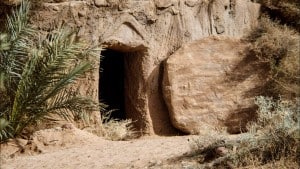
How could Paul promote something so preposterous as the idea that beginning on the Thursday evening of the Passover through Friday evening, Jesus of Nazareth was arrested, tried, beaten, flogged, crucified, and buried—and then arose from the dead on Sunday morning? (See Matt. 26:57,67; 27:1-2,26,59-60; 28:1-10.) We should note carefully that despite the unusual nature of Paul’s claim, his words ring with authenticity, for he cited eyewitness after eyewitness who saw the risen Christ. Of those closest to Jesus, Peter and the apostles saw Him, James did, and Paul himself also saw Him, although later than the others. These words, however, are especially significant: “He was seen by over five hundred brethren at once, of whom the greater part remain to the present, but some have fallen asleep.” Would Paul have dared write this it weren’t true? Of course not. Paul was essentially saying that most of these people still were living and could verify the truth of his words, so anyone who doubted Christ’s resurrection could simply ask them. Here were eyewitnesses numbering in the hundreds!
With regard to those who had been closest to Jesus, the four Gospels—Matthew, Mark, Luke, and John—give details of numerous eyewitness accounts. In reading the Gospels, however, some questions may arise. Why do these reports contain so many differences? Are they contradictions? Did the Gospel writers disagree on what happened?
For example, in John’s account of the initial discovery of the empty tomb, Mary Magdalene is the only woman mentioned (see John 20:1); Matthew, Mark, and Luke all indicated more women were involved (see Matt. 28:1; Mark 16:1; Luke 23:55–24:1).
Also, John stated that when Mary looked into the tomb, she “saw two angels in white sitting, one at the head and the other at the feet, where the body of Jesus had lain” (John 20:12). Luke mentioned two angels in his Gospel as well (see Luke 24:3-8). Matthew and Mark, however, wrote about just one angel (see Matthew 28:2-7; Mark 16:5-7).
Did the Gospel writers contradict one another? Actually, they did not. The various details of the resurrection accounts can be reconciled.
While John wrote only of Mary Magdalene, he did not say she was alone. In fact, in his record of Mary’s words in John 20:2, John actually indicated Mary had company; he wrote that Mary told Peter and John, “They have taken away the Lord out of the tomb, and we do not know where they have laid Him” (emphasis added).
Regarding the number of angels, “Matthew and Mark specify that one angel spoke, but they do not say there was only one angel present or that only one angel spoke. Quite possibly one of the angels served as the spokesman for the two, thus he was emphasized” by the writers of the first two Gospels.1
We notice other differences as well, but these also can be explained. Let’s consider one more example. Matthew was the only Gospel writer who reported that an earthquake occurred and the only one to mention the guards on Easter morning (see Matt. 28:2,4). Apparently he was relating some of the first things that happened that morning, events that took place even before the women arrived (even though he wrote of the women’s making their way to the tomb in verse 1). The fact that the other Gospel writers didn’t mention an earthquake or the guards does not contradict what Matthew said about them.
Had the early followers of Jesus offered accounts with identical details, we would suspect they had gotten together secretly and fabricated the story of Jesus’ resurrection. This obviously did not happen; they could not have made up the testimonies we have in the New Testament—claims that are vividly different, yet that convey the same essential information.
It’s helpful to understand that no writer recorded everything that happened. Upon reflection we also see that no detail in any account conflicts with a detail in another, and the specific elements in all the accounts can be reconciled. Some minor questions may remain, but no troubling ones. As any good lawyer will affirm, this is exactly the kind of testimony we would expect from four eyewitnesses in court—testimonies highlighting a variety of specifics and representing the different perspectives of the witnesses, yet statements with no direct or major contradictions. Speaking in more general terms about the four Gospels, David Limbaugh, himself a lawyer, writes, even though “there are some differences in emphases in the various gospel accounts, what intellectually honest person can read all four books and deny that they put forward a consistent image of Jesus as fully divine and fully human?” 2
Remember, too, that the thrust of each resurrection account offers the same “bottom line”: Jesus’ tomb was empty because He had risen from the dead!
Returning to 1 Corinthians 15, we note that Paul went on to say,
if Christ is not risen, then our preaching is vain and…your faith is futile; you are still in your sins!…But now Christ is risen from the dead, and has become the firstfruits of those who have fallen asleep.…The sting of death is sin, and the strength of sin is the law, but thanks be to God, who gives us the victory through our Lord Jesus Christ (vv. 14,17,20,56-57).
Paul could have ended his discussion of Christ’s resurrection there, but he did not. He concluded with this encouragement for his readers in every age: “Therefore, my beloved brethren, [because Christ is raised,] be steadfast, immovable, always abounding in the work of the Lord, knowing that your labor is not in vain in the Lord” (v. 58). With these words, the apostle highlighted additional evidence for Christ’s resurrection that should consistently be on display in believers’ lives, visible to modern eyewitnesses everywhere. As Jesus said in John 15:5, “I am the vine, you are the branches. He who abides in Me, and I in him, bears much fruit; for without Me, you can do nothing.”
Notes
1Josh McDowell and Don Stewart, Answers to Tough Questions Skeptics Ask About the Christian Faith, (San Bernardino, CA: Here’s Life Publishers, 1980), 53.
2David Limbaugh, Jesus on Trial: A Lawyer Affirms the Truth of the Gospel, (Washington, DC: Regnery Publishing, 2014), 220.
Unless otherwise indicated, Scripture has been taken from the New King James Version®. Copyright © 1982 by Thomas Nelson, Inc. Used by permission. All rights reserved.
Copyright © 2015 by B. Nathaniel Sullivan. All Rights Reserved.
photo credit: www.lumoproject.com
Easter weekend, April 3, 2015
Comments (0)