Affirming the Priceless Contributions of Black Americans to the Cause of Liberty During the Eras of the American Revolution and Reconstruction
Historical records show that 5,000 blacks fought for American Independence. Even without the certainty of their futures, they understood that the risk of dying for freedom was better than the guarantee of living under oppression. Now, if you’re wondering why you’ve never heard about these black heroes, it hasn’t been by accident. After the Civil War, the losers, the Democrats, were allowed to re-write the history books. They knew that the best way to isolate blacks was to remove them from history. But we conservatives are getting wiser and we are making some noise.
—Amy Reid—
Links to all the articles in this series are available here.
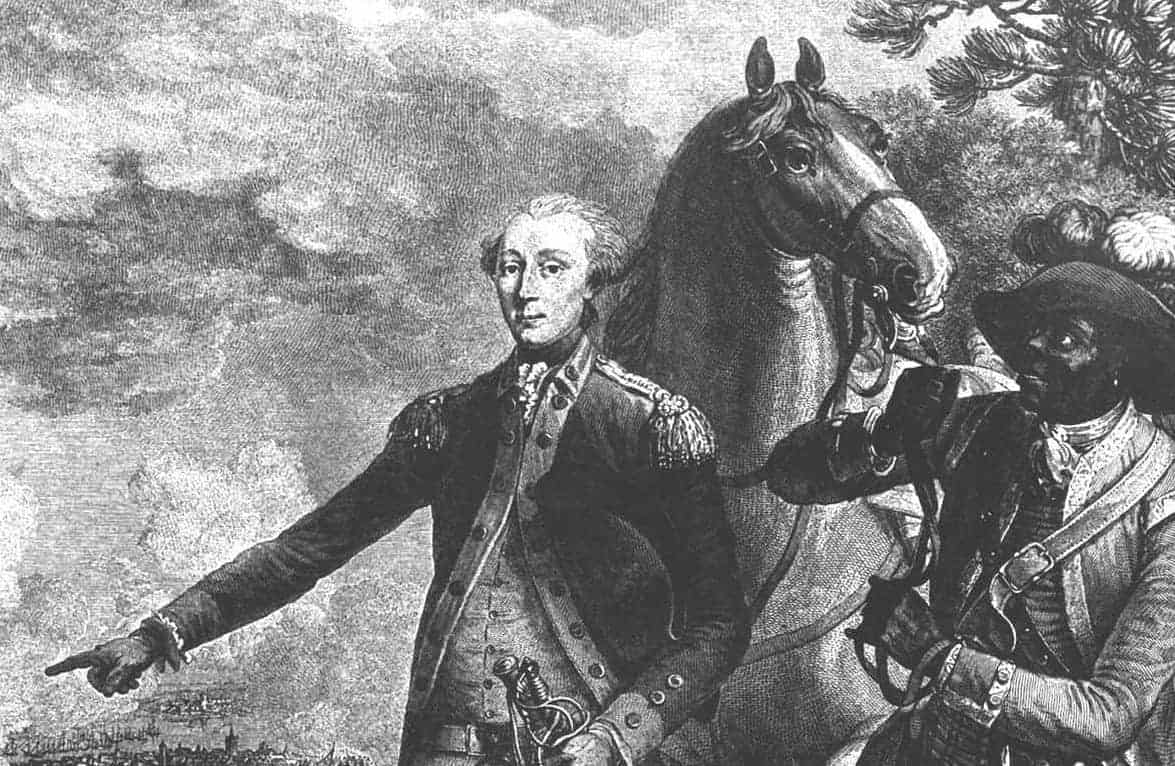
The article cited above is titled “Black Revolutionary War Heroes.” In it, writer and speaker Amy Reid cites some tremendous examples of African American contributions to American Independence and freedom. Specifically, she mentions Crispus Attucks, Peter Salem, Wentworth Cheswell, James Armistead (pictured above with Marquis de Lafayette), Prince Eastabrook, Prince Whipple, and Oliver Cromwell. To this list we can add the name of Salem Poor.

Postage Stamp, 1975
The phrase “Gallant Soldier” on the stamp honoring Poor didn’t come from a 20th century assessment of his actions on the battlefield. Rather, it came from fourteen white officers who saw Poor in action at the Battle of Bunker Hill on June 17, 1775. Several months later, in December, they submitted a petition to the General Court of Massachusetts requesting official recognition of his service. They affirmed Poor had acted “like an Experienced officer, as Well as an Excellent Soldier” and went on to say that it would have been “Tedious” to explain the details of Poor’s military skill, so “We Would Only beg leave to say in the Person of this Negro Centers a Brave & gallant Soldier.”
Amy Reid’s very powerful observation bears repeating: “Now, if you’re wondering why you’ve never heard about these black heroes, it hasn’t been by accident. After the Civil War, the losers, the Democrats, were allowed to rewrite the history books. They knew that the best way to isolate blacks was to remove them from history.”
The Democrats have been allowed to revise history.
This week we begin exploring some of the events from history that Democrats have edited to their advantage. Please know that this article isn’t primarily pro-Republican, or even anti-Democrat. Rather, it is an effort to get to the truth about history.
This article—indeed, all the articles in this series—aren’t primarily pro-Republican, or even anti-Democrat. Rather, they represent concerted efforts to uncover what really happened in history.
When we learn the truth, we find lessons for Democrats and Republicans alike. Democrats need to own up to the the truth. Republicans need to rediscover their roots and once again uphold the founding principles of the Republican party—not just during campaigns to get elected, but especially after they get in office, with their actions.
This week we will examine two important historical truths that Democrats have successfully concealed, and in our next post we will add several more. Get ready for an eye-opening journey. For additional information on each topic, click on the links provided.
Historical Truths Democrats Have Successfully Concealed
First, Many black soldiers fought alongside whites in the Revolutionary War. Their contributions to the cause of liberty and American independence truly were incalculable.
Emanuel Leutze
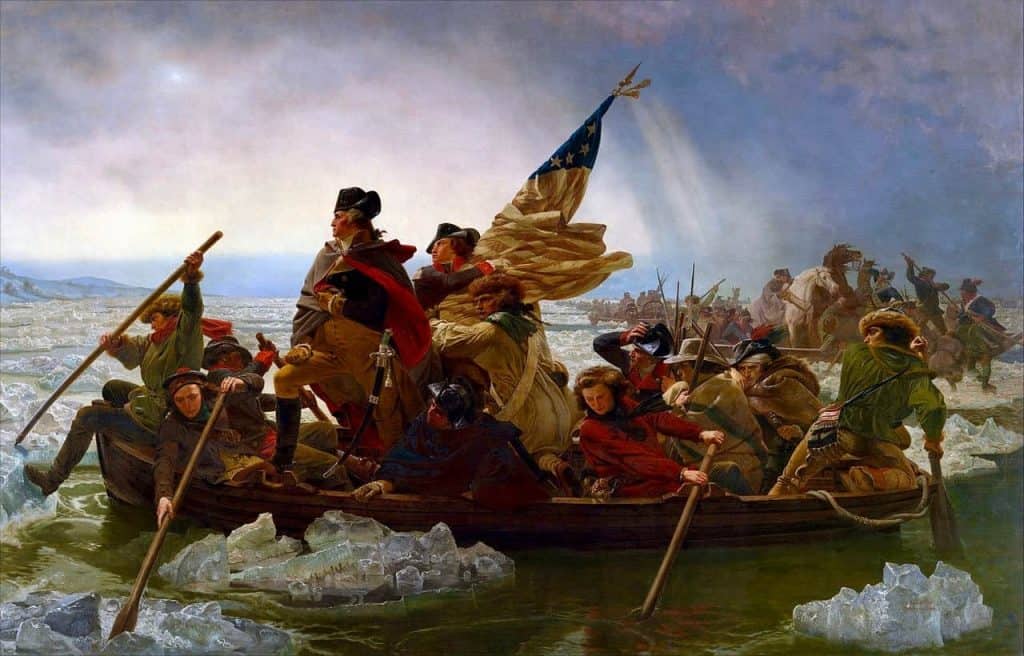
In the painting Washington Crossing the Delaware by Emanuel Leutze (1816-1868), an African American is pictured by Washington’s right knee. He is pushing away ice with his oar. Some have suggested that this man is Prince Whipple. While he may not actually have been with Washington for this pivotal event during the war, Prince Whipple did fight in the American Revolution. Oliver Cromwell, another black soldier in the Revolutionary War, also is pictured in Leutze’s painting. He’s in the bow of the boat, with his left leg hanging over the side. Here we will briefly examine the life and contribution of Prince Whipple and uphold him as an example of many other blacks who fought in the Revolutionary War.
According to historian William C. Nell (1816-1874), author of Colored Patriots of the American Revolution (1851), Prince was born to wealthy parents around the year 1750. At ten years of age, Prince was sent with a cousin from Africa to America to America. His parents wanted him to receive an education there, but the captain of the ship sold them into slavery in Baltimore. General William Whipple, from New Hampshire, purchased Prince.
Later, General Whipple would become a signer of the Declaration of Independence. Nell writes that Prince
was emancipated during the [Revolutionary] War, was much esteemed, and was once entrusted by the General with a large sum of money to carry from Salem to Portsmouth. He was attacked on the road, near Newburyport, by two ruffians; one was struck with a loaded whip, the other one he shot…Prince was beloved by all who knew him. He was also known as “Caleb Quotom” of Portsmouth, where he died leaving a widow, Dinah a freeperson and two children.
Even if Prince Whipple did not accompany Washington in his historic crossing of the Delaware on Christmas night in 1776, the black man depicted in Leutze’s painting represents all the blacks who served in the armed forces to secure American independence. Understandably, because most were enslaved, they wanted to lend aid to whichever side would offer them the greater opportunity for freedom. Historian Edward Ayres writes, “Enslaved blacks made their own assessment of the conflict and supported the side that offered the best opportunity to escape bondage.” Yet there were some who saw potential and benefit in helping give birth to a new nation not beholden to England. A good number of
free and enslaved African Americans in New England were willing to take up arms against the British. As soon states found it increasingly difficult to fill their enlistment quotas, they began to turn to this untapped pool of manpower. Eventually every state above the Potomac River recruited slaves for military service, usually in exchange for their freedom. By the end of the war from 5,000 to 8,000 blacks had served the American cause in some capacity, either on the battlefield, behind the lines in noncombatant roles, or on the seas.…
Most black soldiers were scattered throughout the Continental Army in integrated infantry regiments, where they were often assigned to support roles as wagoners, cooks, waiters or artisans. Several all-black units, commanded by white officers, also were formed and saw action against the British. Rhode Island’s Black Battalion was established in 1778 when that state was unable to meet its quota for the Continental Army. The legislature agreed to set free slaves who volunteered for the duration of the war, and compensated their owners for their value. This regiment performed bravely throughout the war and was present at Yorktown where an observer noted it was “the most neatly dressed, the best under arms, and the most precise in its maneuvers.”
Segregation of troops was not the norm. Blacks “fought, drilled, marched, ate and slept alongside their white counterparts. There was never enough food or clothes or even pay for anyone, but they shared their hardships equally.” Military historian Major Glenn Williams has said, “I’ve heard one analysis say that the Army during the Revolutionary War was the most integrated that the Army would be until the Korean War. World War I and World War II both, and of course the Civil War, there were lots of blacks in uniform, but the men were segregated into separate units.”
Overlooking the brave contributions of blacks who fought and died in the American Revolution is an error that must be corrected. At the end of her article her speech (which we cited earlier), Amy Reid suggested that with regard to the issue of the contributions of blacks to American history, “we conservatives are getting wiser and are making some noise.”
We need to understand that there’s a lot of noise to be made.
Let’s move now to the second point. All of the first black Members of Congress were Republicans. They courageously faced threats and fierce opposition from those who never wanted to free the slaves in the first place, many of whom were Democrats.
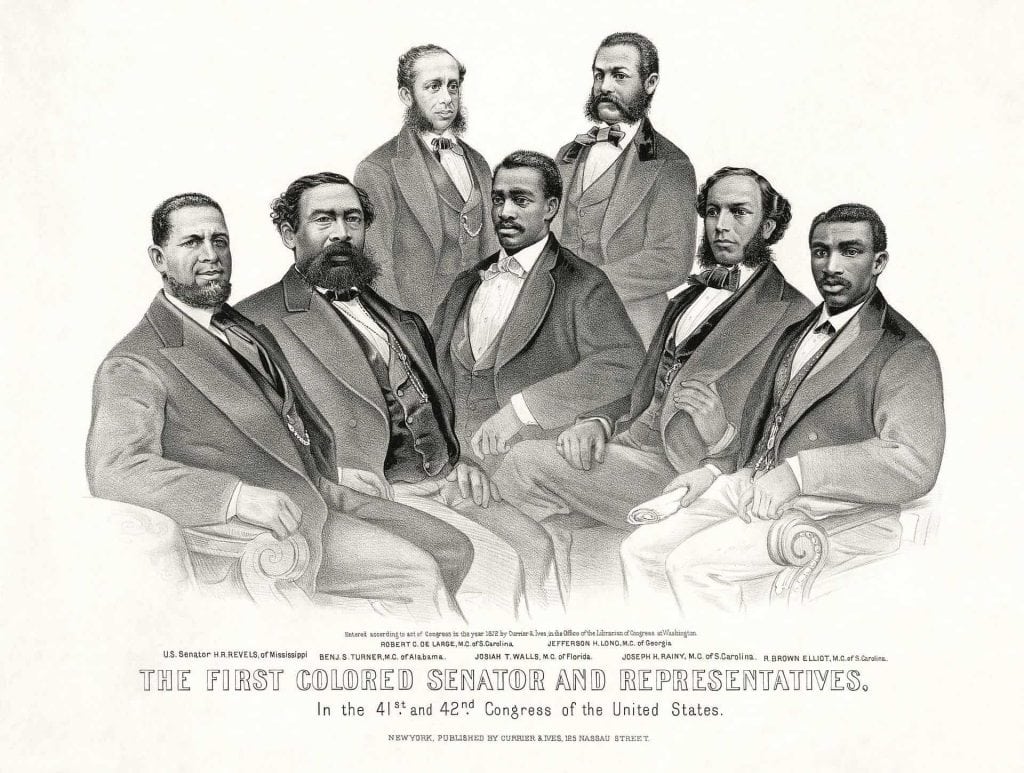
Currier and Ives print: The First Colored Senator and Representatives, December 31, 1871
Meet the first black members of the United States Congress.
- US Senator Hiram Revels (1827-1901) from Mississippi was the first African-American to serve in the United States Congress. He served in the 41st Congress, which lasted from 1869-1871. Also a preacher, Revels was a powerful speaker. He was a lifelong freedman. Even though he“viewed himself as ‘a representative of the State, irrespective of color,’ he also represented freedmen and, as such, received petitions from black men and women from all states.” Yet he also “favored universal amnesty for former Confederates, requiring only their sworn loyalty to the Union.”
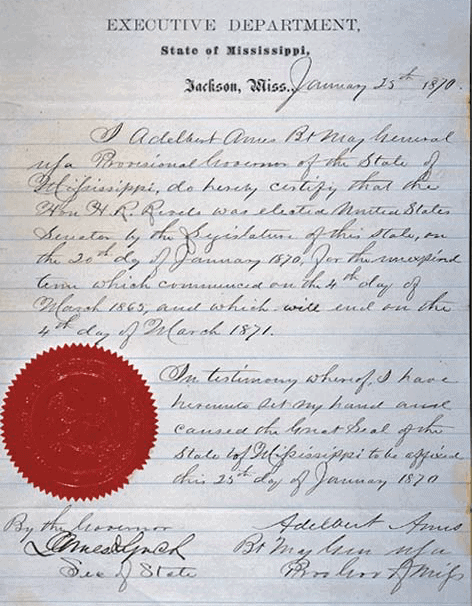
Letter from the Governor and Secretary of State of Mississippi certifying Hiram Rhodes Revels to the US Senate, January 25, 1870
- Benjamin Sterling Turner (1825-1894), a slave, became a successful businessman, then became the first black man to serve in the US House of Representatives from the state of Alabama. He served in the 42nd Congress (1871-1873). Turner’s work in the House of Representatives included efforts to restore the rights of former Confederates. He also sought repeal of a tax on cotton, arguing that it was an especially heavy burden on black Americans. After serving in Congress Turner pulled away from political activity for a time, but in 1880 he participated in the Alabama Labor Union Convention and was a delegate to his party’s political convention in Chicago. He returned to his work in business afterward, but a tough economy ended those efforts. Turner then tried farming but died a poor man on March 21, 1894.
- Robert C. De Large (1842-1874) served in the 42nd Congressas a representative from South Carolina. DeLarge’s parentsmay have been free and members of different races (or of mixed races themselves), but some records indicate he was born a slave. Either way, remarkably, he completed a high school education at Charleston’s Wood High School. Before entering politics he became a tailor, as well as a farmer. He worked in politics at the state level and then was elected to Congress in 1870. De Large “took his seat on March 4, 1871. Placed on the Committee on Manufactures, he also urged legislation to protect Republicans from intimidation and to protect African Americans from racial violence. Unfortunately, [Christopher C.] Bowen [—the opponent he’d narrowly defeated—] weakened DeLarge’s effectiveness by contesting the election and thereby consuming much of the young congressman’s time. The House Committee on Elections began considering C. C. Bowen v. R. C. DeLarge in December 1871 but failed to reach a conclusion until January 1873. At that time they removed DeLarge from office because such irregularities existed in the election as to make the victor impossible to determine. DeLarge did not pursue reelection because his health had already begun to fail.” He died at 31 years of age.
- Josiah Thomas Walls (1842-1905) was born in Virginia as a slave in 1842. He served as a Confederate soldier because he was required to do so, but in 1862 Union troops captured him in Yorktown. He then volunteered to serve on the side of the Union! He became First Sergeant in the US Colored Troops Infantry Regiment. Serving in Union-occupied Florida, he met and married Helen Ferguson from Florida before leaving the Army in 1865. Walls was elected to the Florida Senate for sessions held in 1869, 1870, 1877, and 1879. In 1871, he became the first African American to represent a Florida congressional district in the US house of Representatives. His opponent contested the election, and nearly two years later, Walls was unseated. Still, his “congressional career was not over. In November 1872, he had won one of the two Florida At–Large seats in the 43rd Congress (1873–1875).” Walls narrowly won again in 1874, but his opponent, Jesse J. Finley, contested that election. Walls’ party was now out of power, and the committee in charge of the decision seated Finley. Walls had been involved in the 42nd, 43rd, and 44th Congresses.
- Jefferson Franklin Long (1836-1907), a Georgian, filled a vacancy in the US House of Representatives during the 41stCongress. The remainder of the term he filled lasted only three months—from January 16, 1871 to March 3, 1871. The first African-American to be elected to the US House of Representatives from his state and the second to be elected to the US House, Long gave just one speech to Congress. That speech also was a first—the first to be delivered by an African-American in the US House. Long gave it on February 1, 1871. He “opposed a measure which would remove voting restrictions on ex-Confederate political leaders because he felt these men still posed a threat to African Americans political freedom if allowed to regain power.” He declared, “If this House removed the disabilities of disloyal men, I venture to prophesy you will again have trouble from the very same men who gave you trouble before.” Long’s efforts to oppose Confederate amnesty failed, and two weeks later, President Grant allowed the legislation to become law without his signature. In less than a month, Long’s term had expired. The former congressman returned to Georgia and campaigned for candidates in his party. Encouraged by Long, a group of freedmen went to the polls together to vote on election day in 1872. Armed white thugs incited a riot to prevent them from voting. Violence erupted and four from Long’s group were killed. Discouraged, Long pulled away from political involvement and focused on business endeavors thereafter. He died in early February, 1907.
- Joseph Hayne Rainey (1832-1887), was from South Carolina. He was the first black American to be elected to the United States House of Representatives. Born a slave, he acquired his freedom when his father purchased it for him and the rest of the family in the 1840s. In 1861, Rainey was conscripted into the Confederate armed services. He served on a ship and was able to escape to Bermuda in 1862. He returned to South Carolina soon after the war. Rainey was part of several Congresses—the 41st, 42, 43rd, 44th, and 45th. He died on August 1, 1877.
“We [Black Americans] are earnest in our support of the Government. We are earnest in the house of the nation’s perils and dangers; and now, in our country’s comparative peace and tranquility, we are earnest for our rights.”
—Representative Joseph Hayne Rainey—
- Robert Brown Elliott (1842-1884) represented constituents in his district in South Carolina during the 42nd and 43rdCongresses. We don’t know much about Elliott’s early years. He may have been born in England to a couple from the West Indies. At 25 years of age, came to South Carolina and began practicing law. He served in the South Carolina House of Representatives after being elected in 1868. South Carolina Governor Robert Scott appointed Elliott as the state’s assistant adjutant general. In this capacity, Elliott was authorized to lead militia across the state to defend blacks from attacks by the Ku Klux Klan. In 1870, he won the congressional seat for the district that included South Carolina’s capital, Columbia. He was well-educated, eloquent, and had a natural confidence that he used to his advantage. Some were apprehensive and wary, as he was willing to push for stronger civil rights legislation for blacks than were other African-American congressmen. Also, being very dark skinned, he was called Congress’ first “genuine African.” History.house.gov, the history website of the House of Representatives, says of Elliott, “Rising racial violence in his home state stirred Elliott to speak. Just before Christmas 1870, a white whiskey peddler allegedly was killed by a group of drunk, black militiamen in the town of Union Courthouse, South Carolina. Thirteen men were arrested in connection with the crime, but before they were tried, the Ku Klux Klan raided several jails, executing the suspects. The Klansmen subsequently posted a notice on the Union Courthouse jail door justifying the lynchings and warning other African Americans in the state.” Later, Elliott delivered a speech in which “he read the letter posted by the Klansmen at the Union Courthouse jail, following it with words about the prejudice against his race: ‘It is custom, sir, of Democratic [newspapers] to stigmatize the negroes of the South as being in a semi–barbarous condition; but pray tell me, who is the barbarian here, the murderer or the victim? I fling back in the teeth of those who make it this most false and foul aspersion upon the negro of the southern States.’”
It is custom, sir, of Democratic [newspapers] to stigmatize the negroes of the South as being in a semi–barbarous condition; but pray tell me, who is the barbarian here, the murderer or the victim? I fling back in the teeth of those who make it this most false and foul aspersion upon the negro of the southern States.
—Robert Brown Elliott—
Elliott was reelected in 1872 and was very effective in his work in Congress, but he felt his party needed him more in his home state of South Carolina. He resigned his congressional seat in early November, 1784. He subsequently won a seat in South Carolina’s general assembly and was elected Speaker of the House. He was the second black to serve as Speaker in that body. He died on August 9, 1884.
It is very significant that all of these men, and more like them to follow, were Republicans.
In this video, David Barton of WallBuilders introduces his viewers to these great Americans.
The above clip is part of a larger presentation by David Barton. Continue scrolling down for more information.
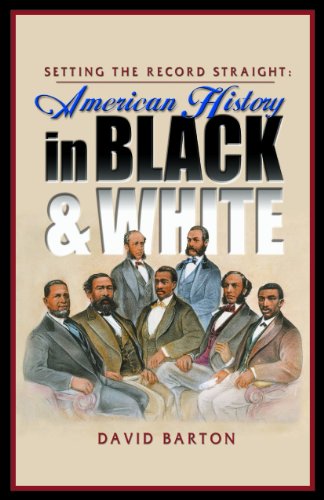
For further study: Setting the Record Straight: American History in Black and White, book and DVD, available from WallBuilders
The video presentation also is available on YouTube.
Links to all the articles in this series are available here.
Copyright © 2016 by B. Nathaniel Sullivan. All Rights Reserved.
Word Foundations
3 months ago[…] In Part 6, we began to record some historical facts Democrats have hidden from the public or effectively […]