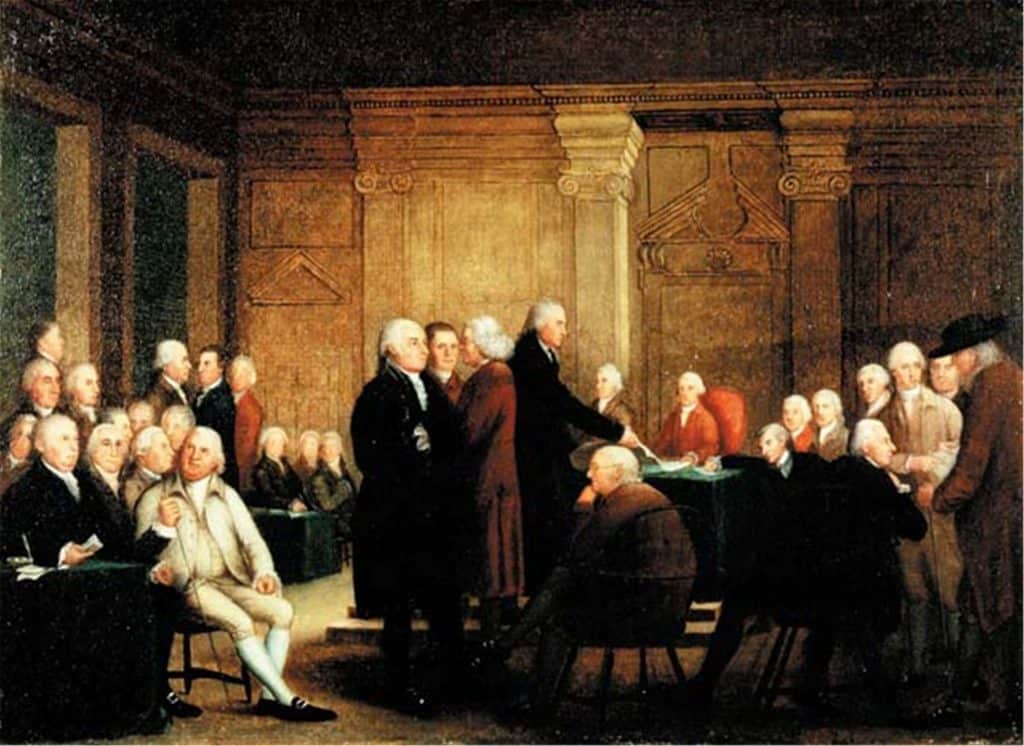
and How the Founders’ Understanding of it Eventually Put and End to Slavery
We hold these truths to be self-evident, that all men are created equal, that they are endowed by their Creator with certain unalienable Rights, that among these are Life, Liberty and the pursuit of Happiness.
—The United States Declaration of Independence and the 56 men who risked everything when they signed it—
The two appearances of the word “equal” in the Declaration of Independence both refer to a “starting point” for human beings under the law.
—Larrey Anderson of the conservative website American Thinker—
Key point: Unfortunately, today, Americans have divorced the idea of human equality from a belief in God, even though He is its author.
This article is Part 1 of a series.
A reproducible PDF file of this post is available here.
In this post, I’d like to explore the theme of equality as it is presented in the Declaration of Independence. Initially we will draw from a previous Word Foundations article, “Principles of Liberty, Part 2.” In turn, this article draws from a variety of sources, including some at Word Foundations.
Understandably, many people today ask, Why did the Founders state that “all men are created equal” but not abolish slavery? It’s an important question. Yet to be fair we must
evaluate our Founders not in light of our own culture, but in light of theirs; America’s “Founders were born into a society that permitted slavery.”1 Despite this, some swam against the tide as they expressed resistance and even opposition to the practice.
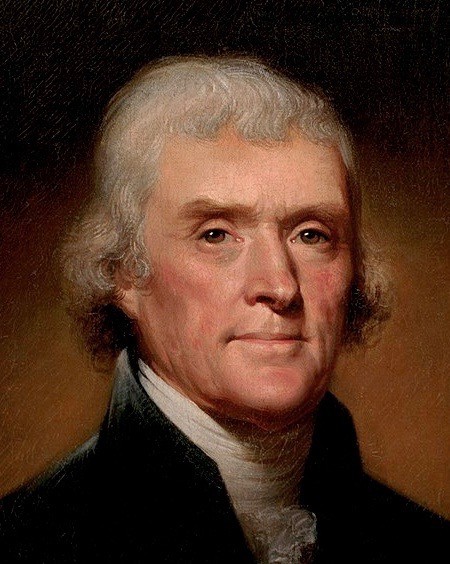
Thomas Jefferson / official presidential portrait
Thomas Jefferson, himself a slaveowner, was one such man. In his original draft of the Declaration (he was the Declaration’s principal author), he took the King of England to task for his role in the slave trade. He wrote,
He has waged cruel war against human nature itself, violating it’s most sacred rights of life and liberty in the persons of a distant people who never offended him, captivating & carrying them into slavery in another hemisphere, or to incur miserable death in their transportation thither. This piratical warfare, the opprobium of INFIDEL Powers, is the warfare of the CHRISTIAN king of Great Britain. Determined to keep open a market where MEN should be bought & sold, he has prostituted his negative for suppressing every legislative attempt to prohibit or to restrain this execrable commerce. And that this assemblage of horrors might want no fact of distinguished die, he is now exciting those very people to rise in arms among us, and to purchase that liberty of which he has deprived them, by murdering the people on whom he also obtruded them: thus paying off former crimes committed against the LIBERTIES of one people, with crimes which he urges them to commit against the LIVES of another.
In this paragraph, Jefferson harshly condemned King George III; yet ironically, he also condemned the slaves by implication, at least with regard to certain actions (not, we should note, with regard to the color of their skin). Still, we are foolish to ignore the strength of Jefferson’s case against slavery, one that was all the more remarkable because it was penned during an era when, and in a culture where, the practice was embedded in everyday life.
Pointing the New Nation in the Right Direction
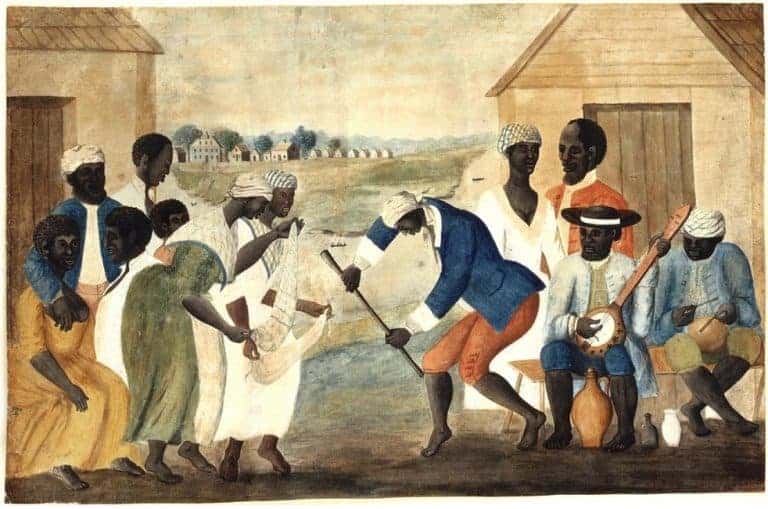
Slaves on a South Carolina plantation / The Old Plantation / around 1790
Let’s note carefully some very striking things about Thomas Jefferson’s paragraph. Jefferson refers to slaves as “persons” and “MEN,” and he accuses the king of having “waged cruel war against human nature itself, violating it’s most sacred rights of life and liberty in the persons of a distant people who never offended him.” We can scratch our heads in bewilderment over what to us appears to be Jefferson’s hypocrisy; but more realistically, doesn’t it appear that these are the actions and that this is the perspective of a man whose conscience has been stirred, but who knows he cannot overturn this aspect of the cultural landscape in a split second?
Robert George / Gage Skidmore
Do not be too quick to condemn! Had you lived during that era and benefitted from slavery economically and in other ways, do you really think you would have abandoned it altogether and fought against it, taking an extremely unpopular stand? Dr. Robert George of Princeton University has posed this question to his students, and nearly all of them indicated they believed they would have readily opposed slavery. Dr. George encouraged them, and he encourages all of us, to think again! Against the backdrop of Dr. George’s insights, we can see just how remarkable Thomas Jefferson’s criticism of King George with regard to the slave trade really was.
The Second Continental Congress had appointed a “Committee of Five,” of which Jefferson was a part, to write a rough draft of the Declaration. Jefferson was selected by the committee to write an initial draft, which was then subject to review by the rest of the committee, and then the entire Congress.
When the edits were made, the paragraph on slavery was struck, so the Declaration did not, and does not, condemn slavery explicitly. Yet it does so implicitly! Statements that remained in the document would prove in the decades ahead to be extremely powerful weapons against institutional slavery and other societal wrongs. While
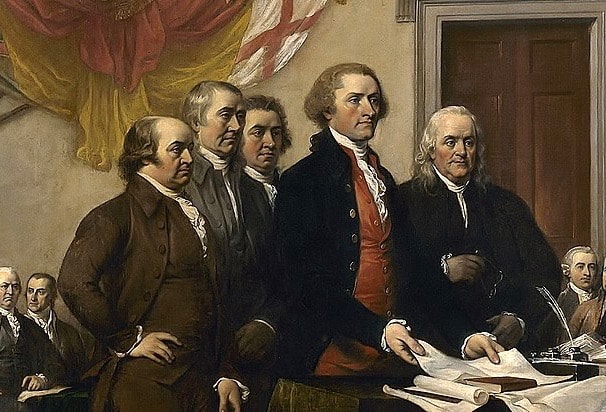
John Trumbull / Declaration of Independence / left to right: Adams, Sherman, Livingston, Jefferson, and Franklin
the Founders did not immediately free the slaves, give votes to their wives, or invite the Indian tribes to sign the Declaration with them…all of the greatest advocates for human equality in America—Abraham Lincoln and Frederick Douglass, Elizabeth Cady Stanton and the Suffragettes, Martin Luther King Jr.—pointed to this passage in the Declaration to give force to their demands for justice.2
Significantly, it didn’t take long for the idea of human equality to bear positive fruit. Although stated slightly differently, the truth that “all men are born free and equal” became a part of the state constitution of Massachusetts — and in 1781, two slaves in western Massachusetts sued for their freedom and won! Their case was an important step in bringing a complete end to slavery in Massachusetts a few years later. In 1776 when the United States of America was established with the adoption of the Declaration of Independence, slavery was legal in all of the thirteen colonies.
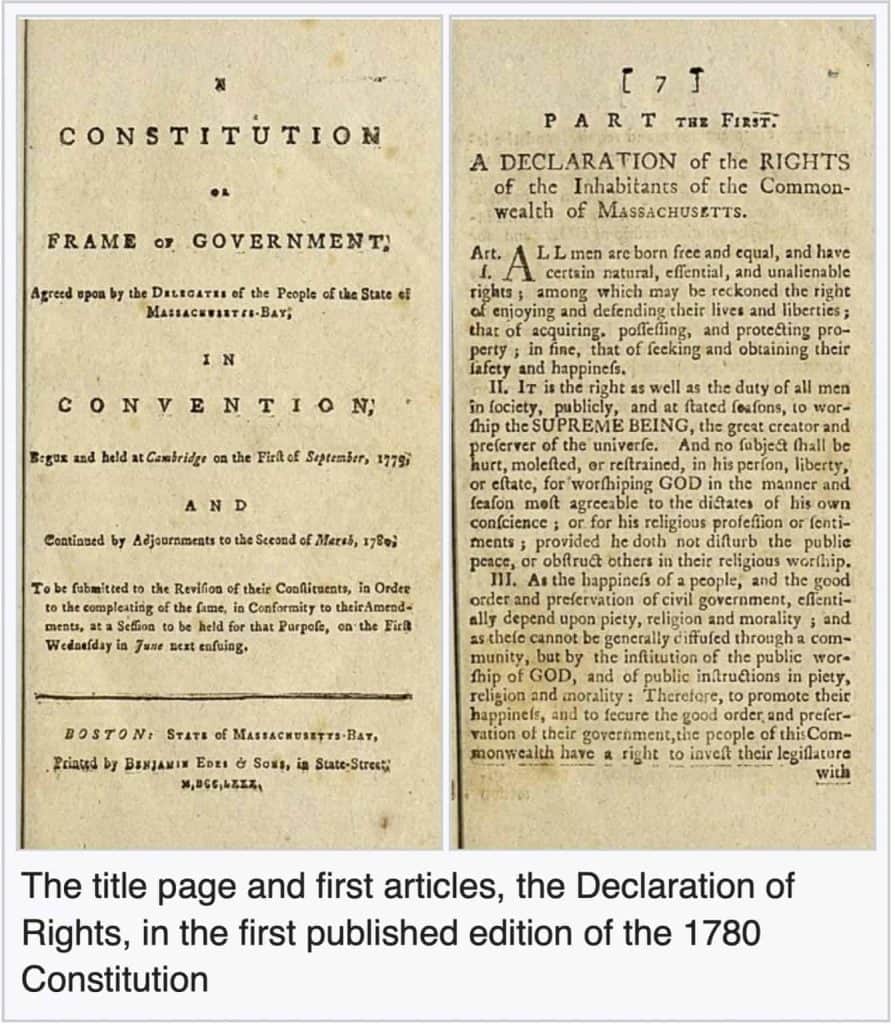
Wikipedia Commons / PDF file
Exploring the Founders’ Concept of Equality — and Contrasting it to that of Americans Today
Thus, the concept that “all men are created equal” became one of the most powerful ever upheld by a nation. We can be grateful for this in many ways, but a word of warning is in order.
In recent decades, Americans foolishly have rallied around the banner of equality alone when, in this instance where the word equal appears on America’s “birth certificate,” its meaning is informed, tempered, and shaped by the word created. Created, in turn, is linked inseparably to the term Creator. The implications of these realities, of course, are enormous.
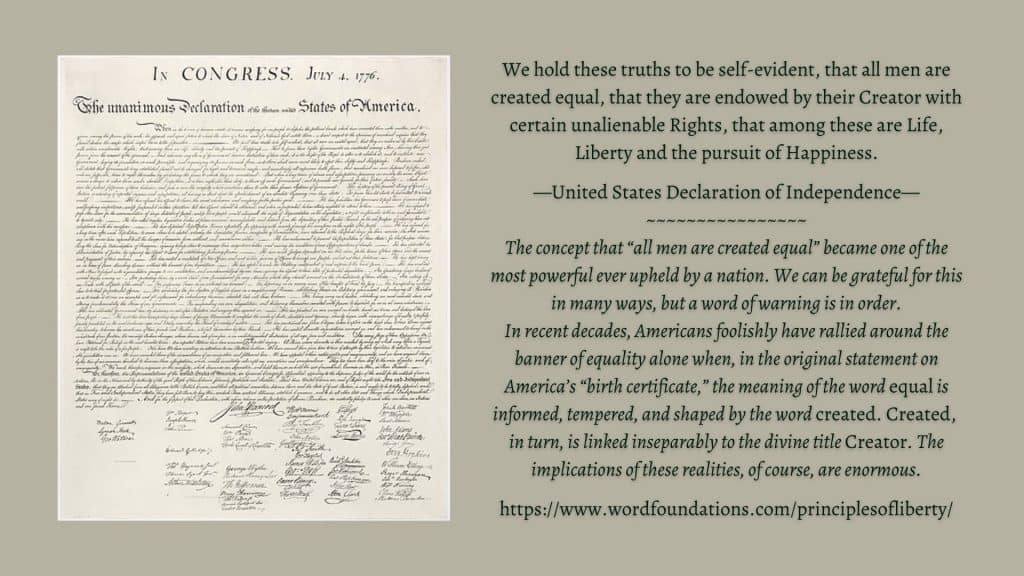
What did Thomas Jefferson and the other signers of the Declaration of Independence mean when they stated that “all men are created equal”? We learn a great deal about what they meant when we read the entire sentence:
We hold these truths to be self-evident, that all men are created equal, that they are endowed by their Creator with certain unalienable Rights, that among these are Life, Liberty and the pursuit of Happiness.
The Founders could not have meant that everyone is identical, possessing the same talents and gifts, the same intellectual capacity, and the same physical abilities, to name just a few categories of traits people possess. It is manifestly self-evident that each individual human being is unique. America’s early leaders instead insisted that “all men are created equal” in that they are “created” by God and in that “they are endowed by their Creator with certain unalienable Rights, that among these are Life, Liberty and the pursuit of Happiness.”
America’s early leaders insisted that “all men are created equal” in that they are “created” by God and in that “they are endowed by their Creator with certain unalienable Rights, that among these are Life, Liberty and the pursuit of Happiness.”
Even More Clues to the Meaning of Equality Are Found in the Bible
Even though many Americans don’t realize it, the equality the signers of the Declaration upheld is deeply rooted in Scripture. Note that the signers held that certain truths are self-evident. They were not relativists; they did not believe that someone could make up his or her own truth and be just as in touch with reality as the one who didn’t but instead cooperated with the world as it is. That which was and is self-evident, in fact, is self-evident because of what “the Laws of Nature and of Nature’s God” reveal (see Rom. 1:18-20; 2:14-16).
That which was and is self-evident, in fact, is self-evident because of what “the Laws of Nature and of Nature’s God” reveal.
From where does the idea (and ideal) of equality come? It comes from God! Members of the human race are created equal by God because He makes every individual person in His image (see Gen. 1:26 -28; 9:6). Note the clear teachings of the passages in Genesis we just cited (plus one from Psalms).
-
- Being made in God’s image is unique to humans; no plant or animal bears the divine image — only people (Gen. 1:27; Ps. 8:1-9).
- God makes both males and females in His image (v. 27).
- Males and females are equal in that they are both human, but they clearly are different in order to fulfill different roles (v. 27; see also 2:18-25; 3:16-20). This does not mean that a wife and mother must never work outside the home; nor does it mean that a husband and father should never be a stay-at-home dad. Specific family responsibilities ought to be agreed upon by each married couple. It does mean that men and women are different and, generally speaking, men are better able to protect and provide for their families, and women better able to nurture and encourage. These facts also are self-evident.
- God wants people to engage in constructive and productive work, to be busy making the most of the opportunities before them (1:28).
- God is a God of order and involves people in the process of establishing and maintaining order (all of Gen. 1, especially v. 28; also see Ps. 104:10-25, especially v. 23).
- Life is the most basic of rights; no one has the right or the authority to take the life of an innocent human being. If someone does commit murder, it is legitimate for the state to hold the murderer accountable, taking the murderer’s life for violating another person’s right to life (see Gen. 9:6).
Now, while the 56 men who signed the Declaration were not thinking primarily in theological terms, they still believed numerous biblical truths as the basis for their convictions. Moreover, they were not ashamed to do so; we see evidence of this in that in the Declaration, they mentioned early and favorably “the Laws of Nature and of Nature’s God.” Significantly, this phrase appears within the first 100 words of the document, which contains a total of just over 1,300 words. We can put it yet another way: The words the signers used and the imagery they employed in America’s founding document point without ambiguity to biblical concepts and ideals.
The words the Founders used and the imagery they employed in America’s founding document point without ambiguity to biblical concepts and ideals.
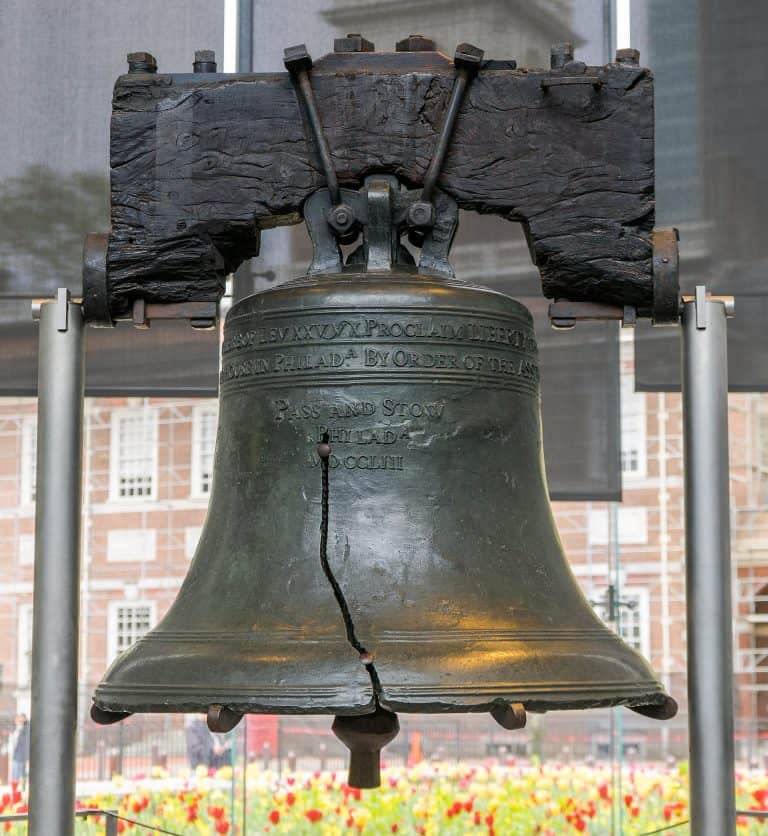
Liberty Bell / Photo credit: William Zhang, Wikipedia Commons

It cannot be denied that the equality-among-men that Jefferson, the Committee of Five, and the delegates to the Second Continental Congress promoted and upheld is not one achieved through societal manipulation or government intervention, but one that already exists. Just as the rights the Founders affirmed were innate or “unalienable” because they are rooted in divine creation, so, too, was and is human equality itself. It is an equality, not of outcomes, but of opportunity; so it is an equality government has a duty to recognize and protect. No, not all have the same opportunities; but all ought to be equally free to pursue the opportunities they have and the opportunities they carve out for themselves without violating the unalienable rights of others. As Larrey Anderson affirms in the quote we cited at the top of this post, the Declaration sees equality as a “starting point” for all the nation’s citizens. Again, government can’t engineer it, for if it did, it would create an unequal playing field, favoring some over others!
Is a “hands-off” approach by the government fair? Yes! Actually, a “hands-on” approach by the government would interfere with God-given equality.
So, what about those who are less gifted? How can they compete? If government stays out of the way, then they have natural handicaps that hinder their performance. I believe the Founders would say three things in response to this (or that what they would say would align with these three points).
First, a person may have natural handicaps in one area, but most do not have handicaps in all areas. A person who can’t compete in one arena will be suited to excel in another; he or she needs to take advantage of and create opportunities to tackle projects he or she is gifted to tackle. As we have stated already, because the innate differences between people are self-evident, the Founders could not have seen equality as meaning that all are identical, having the same talents, abilities, and resources at their disposal.
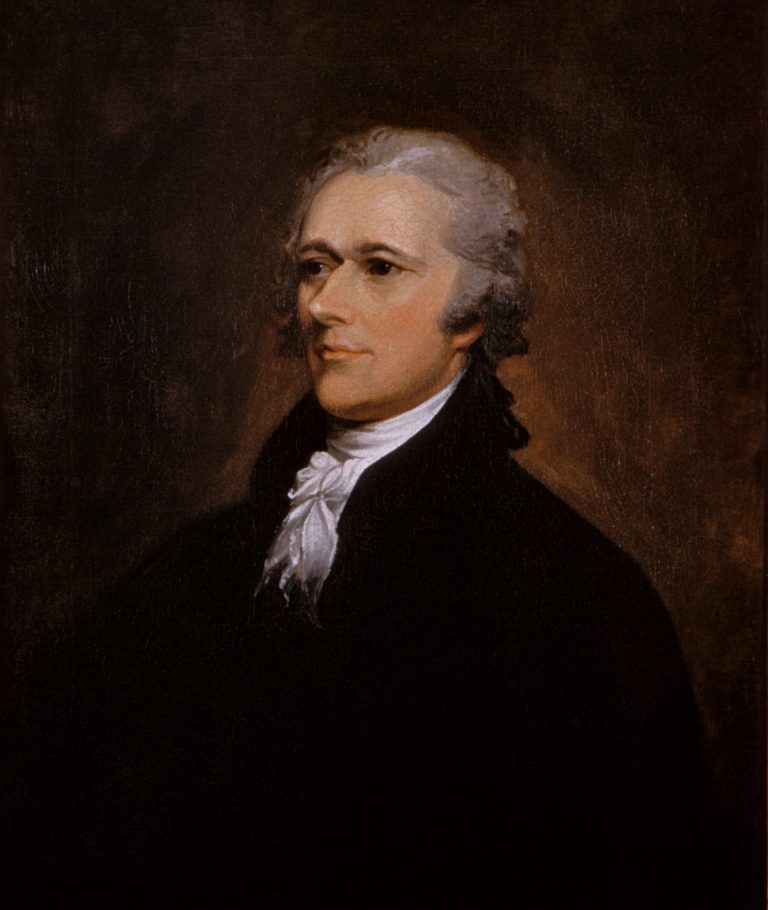
Alexander Hamilton
Second, people absolutely aren’t on an equal playing field if their rights aren’t protected. It’s a different story, however, if government does its job of protecting people’s rights by not interfering itself with their legitimate and lawful pursuits and by not allowing other people to interfere with them. It is government’s God-given duty to create as fair a climate for all to the extent that it legitimately can.
Founding Father Alexander Hamilton said, “There can be no truer principle than this—that every individual of the community at large has an equal right to the protection of government.”
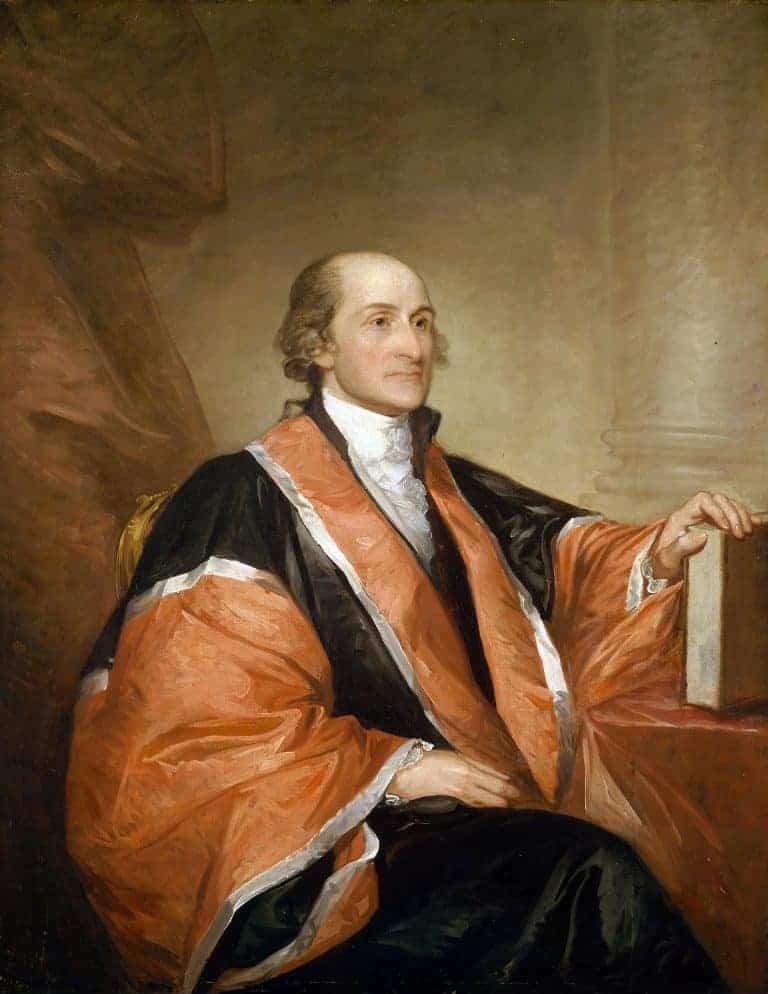
John Jay
Founding Father John Jay put it this way: “Justice is indiscriminately due to all, without regard to numbers, wealth, or rank.” Mark it down! The justice of which John Jay spoke is not achieved through government redistribution of wealth to engineer equal outcomes. That is the “social justice” definition of justice. John Jay was referring the need of a nation for biblical justice to prevail. He was referring to government’s obligation to protect God-given rights so that people can pursue their dreams in an unhindered fashion. How does government protect inherent, God-given rights? By fulfilling its duties as described in Romans 13:1-7 and 1 Peter 2:13-17, and by maintaining order as commended in 1 Timothy 2:1-4.
Third, in any society, some can’t engage in productive work because of certain realities beyond their control, limitations that prevent them from doing so. In 2 Thessalonians 3:10, Paul wrote to the Christians at Thessalonica, “For even when we were with you, we commanded you this: If anyone will not work, neither shall he eat.”
Note that Paul did not indicate that those who cannot work should not be allowed to eat, but that those who will not work should not be enjoying meals at others’ expense. The families of those unable to take care of themselves should have primary responsibility for feeding and caring for them. While government may have a role in providing some assistance in some cases, Americans have, unfortunately, come to rely on the government too much in just about all cases — and here we’re talking, not only about cases in which an individual can’t work, but numerous other situations as well.
Government “assistance” is everywhere in America today, but this hasn’t always been the case. How did we survive as a nation before the government became so eager to “help”? Quite well, actually! This PragerU video describes one such instance. Yes, this is one instance, but it was a big one!
The bottom line here is that nowhere does Scripture say or even imply that it is government’s responsibility to meet the people’s needs. That is not government’s job.
In conclusion, let’s return to considering the concept of equality from the perspective of the Founding Fathers. To them, equality was a God-given attribute in which unalienable rights are deeply rooted and in which they find their sustenance. Moreover, it is one of the components in the foundation for limited government, since it says government’s responsibility isn’t to provide for citizens but to create a favorable climate for them to work to meet their own needs and pursue their own dreams themselves.
And there’s more! Next time, we’ll explore ten specific ways the equality the Founders upheld promotes authentic liberty, and how the modern American definition of equality hinders it.
As they used to say in the days of old time radio, “Don’t touch that dial!” You won’t want to miss part 2!
Copyright © 2022 by B. Nathaniel Sullivan. All rights reserved.
Unless otherwise indicated, Scripture has been taken from the New King James Version®. Copyright © 1982 by Thomas Nelson, Inc. Used by permission. All rights reserved.
top image credit: Robert Edge Pine, A depiction of the Second Continental Congress voting on the United States Declaration of Independence

Notes:
1William J. Bennett, America, the Last Best Hope—Volume 1: From the Age of Discovery to a World at War, 1492-1914, (Nashville: Thomas Nelson, 2006), 122.
2Bennett, 86.
Comments (0)